



The RWA tokenization platform development cost in 2026 can range from around $35,000 for a focused MVP to $500,000+ for an enterprise-grade platform.
There is no single price because an RWA platform can be very simple or highly complex. A platform built for one asset type, one blockchain, and a limited investor group will cost much less than a platform supporting multiple asset classes, jurisdictions, custodians, compliance systems, and secondary trading.
The cost also depends on something that is sometimes overlooked: the legal and compliance structure behind the token.
An RWA platform is not simply a website connected to a blockchain. It may involve asset verification, legal entities, investor onboarding, KYC and AML checks, smart contract development, token standards, wallets, custody, payment systems, reporting, and regulatory controls.
This guide explains the major factors that influence RWA tokenization platform development cost, including features, token standards, compliance requirements, blockchain selection, technology, development time, and ongoing expenses.
Why RWA Platforms Are Becoming More Important
Tokenization is gaining interest since the infrastructure needed to write blockchain contracts makes some asset management and investment functions programmable.
Businesses can leverage blockchain for use cases such as ownership and transfer records, settlement, investor access, distributions, and more.
Tokenization could potentially provide a new way to split assets into smaller pieces.
For instance, rather than one investor having to buy a whole asset, a well-structured offering could enable a number of investors to own digital interests associated with that asset.
However, asset verification, investor protection, custody, legal documents, and regulation are not eliminated by tokenisation.
Actually, these areas may turn out to be among the critical regions of an RWA platform.
How Much Does It Cost to Build an RWA Tokenization Platform in 2026?
The cost depends mainly on the scope of the platform.
| Platform Type | Typical Scope | Estimated Development Cost |
| Focused MVP | One asset type, one blockchain, basic KYC, token issuance, and investor dashboard | 35,000–80,000 |
| Mid-Level Platform | Multiple asset types, compliance workflows, wallets, portfolio management, and integrations | 80,000–200,000 |
| Custom Platform | Advanced token infrastructure, custody, APIs, reporting, and more complex workflows | 150,000–300,000+ |
| Enterprise Platform | Multi-chain infrastructure, advanced compliance, custody, marketplace, and institutional integrations | 200,000–500,000+ |
These numbers should be treated as software-development estimates, not the complete cost of launching an RWA business.
Legal structuring, licensing, asset verification, KYC/AML providers, custody, insurance, smart-contract audits, infrastructure, regulatory work, and ongoing compliance can create additional costs.
What Actually Drives RWA Tokenization Platform Development Cost?
The blockchain itself is only one part of the budget.
The larger cost difference usually comes from the business model and the amount of infrastructure that needs to be built around the asset.
1. Asset Type
The type of asset to be tokenized has an impact on the platform design.
For real estate, you might require: Property documents, ownership documents, valuation, rent, and distribution management. Businesses that want to explore tokenizing real estate on-chain will have to identify how the legal structure and ownership rights of the real estate property sit with legal compliance rules and the underlying architecture.
Private credit might not need loan information, the repayment plan, servicing data, and financial reporting.
Other asset classes may have entirely different needs.
The more sophisticated the asset and the supporting processes, the more work will be needed on the platform.
2. Legal and Compliance Structure
An RWA platform may need to determine:
- Who legally owns the underlying asset?
- What rights does the token represent?
- Who is allowed to purchase it?
- Which jurisdictions can investors come from?
- Are transfer restrictions required?
- What KYC and AML checks are needed?
- Is an approved custodian required?
- What records and reports need to be maintained?
These decisions affect both the technology and the development budget.
3. Custody Model
A platform that allows users to connect their own wallets has a different architecture from one that provides custodial or institutional wallet infrastructure.
MPC wallets, custody providers, transaction approval workflows, and institutional controls can increase development complexity.
4. Blockchain Selection
Ethereum, Polygon, Arbitrum, Base, Solana, and other networks can be considered for RWA applications.
The right choice depends on transaction costs, ecosystem, wallet support, custody integrations, developer tools, token standards, liquidity, and the needs of the target investors.
5. Secondary Trading
A platform that only issues tokens is considerably simpler than one that also provides a secondary marketplace.
Secondary trading introduces additional requirements around eligibility, transfer restrictions, settlement, custody, pricing, liquidity, and regulatory controls.
Key Features of an RWA Tokenization Platform
A modern RWA platform normally has three main areas:
Issuer Dashboard
The issuer side can include:
- Asset onboarding
- Asset documentation
- Offering creation
- Token supply management
- Investor management
- Distribution management
- Redemption requests
- Reporting
- Asset performance information
Investor Dashboard
The investor experience can include:
- Account registration
- KYC verification
- Eligibility checks
- Asset discovery
- Investment
- Wallet connection
- Token holdings
- Portfolio tracking
- Distribution history
- Redemption requests
Admin and Compliance Dashboard
The administrative layer can manage:
- KYC/AML status
- Investor eligibility
- Documents
- Transfer approvals
- Transaction monitoring
- Token supply
- User permissions
- Compliance records
- Reports
- Audit trails
For an enterprise platform, APIs, custody integrations, analytics, corporate actions, and marketplace infrastructure may also be required.
Token Standards for RWA Tokenization
Token standards are an important part of RWA platform architecture because the standard determines what the token can do and how it interacts with the rest of the blockchain ecosystem.
For simple digital assets, standards such as ERC-20 may be sufficient in some situations. NFTs and unique assets may use standards such as ERC-721, while ERC-1155 can support multiple token types.
RWA platforms can have more demanding requirements.
A token representing a regulated investment may need identity checks, transfer restrictions, investor eligibility rules, and other controls.
This is where permissioned token standards such as ERC-3643 can become relevant. ERC-3643 is designed for permissioned tokens and supports identity and compliance conditions at the token-transfer level.
The choice should not be made simply because one standard is popular.
It should be based on:
- The legal rights represented by the token
- Asset type
- Investor requirements
- Compliance model
- Transfer restrictions
- Blockchain compatibility
- Wallet and custody support
- Interoperability requirements
Token standards can therefore affect development cost. A basic token contract may be relatively straightforward, while a permissioned RWA token can require identity, compliance, transfer control, and administrative functionality.
Compliance Frameworks for RWA Tokenization
Compliance is one of the biggest differences between a normal blockchain application and an RWA platform.
A platform dealing with regulated assets may need to verify investors before allowing them to purchase or transfer tokens.
Depending on the jurisdiction and asset, the platform may include:
- KYC verification
- AML screening
- Sanctions screening
- Investor eligibility checks
- Accredited or qualified investor checks where applicable
- Geographic restrictions
- Wallet whitelisting
- Transaction monitoring
- Transfer restrictions
- Compliance reporting
- Document management
- Audit trails
The exact framework depends on where the platform operates and what the token represents.
For example, in the European Union, MiCA provides a regulatory framework for certain crypto-assets and crypto-asset service providers, but financial instruments that fall under existing financial-services legislation are outside MiCA’s scope and remain subject to the applicable financial-services rules.
In the United States, the regulatory treatment of a tokenized asset depends on its legal characteristics. The SEC’s January 2026 statement specifically discusses tokenized securities and different tokenization models.
This is why an RWA platform should not treat compliance as a feature that can simply be added at the end.
The regulatory model should be understood before the technical architecture is finalized.
Regulatory Requirements and RWA Platform Development
Regulation can have a direct effect on development cost.
For example, a platform operating in one jurisdiction with one investor category may have a relatively simple compliance workflow.
A platform operating across multiple jurisdictions may need different rules for different investors.
The system may need to determine:
Investor → Jurisdiction → Eligibility → KYC/AML Status → Asset Rules → Investment Permission → Transfer Permission
This logic can then connect with the token and wallet infrastructure.
Regulatory requirements can also affect:
- Investor onboarding
- Token issuance
- Transfer rules
- Custody
- Reporting
- Data storage
- Record keeping
- Redemption
- Secondary trading
The important point is that blockchain does not replace regulation.
The legal and economic nature of an asset does not automatically change simply because it is represented on a blockchain. The SEC has also emphasized this principle in its discussion of tokenized securities.
For this reason, legal and regulatory advice should be obtained for the specific asset and jurisdiction before launching the platform.
Compliance and Legal Architecture
A practical RWA platform can follow an architecture such as
Real-World Asset → Legal Structure → Investor Eligibility → Token Issuance → Wallet → Transfer → Settlement
The legal structure may involve an issuer, fund, special-purpose vehicle, custodian, administrator, or other entities depending on the asset.
The technology should be designed around this structure.
For example, if only verified investors can hold the token, the platform needs a way to connect identity and eligibility information with wallet addresses and token-transfer rules.
This is very different from launching a normal unrestricted token.
Smart Contracts and RWA Tokenization
Smart contracts form the on-chain foundation of the platform.
They may manage:
- Token issuance
- Minting
- Burning
- Transfers
- Investor restrictions
- Distribution logic
- Redemptions
- Ownership records
- Corporate actions
For EVM-based platforms, Solidity is commonly used, along with established libraries and development tools.
The complexity of these smart contracts depends on the business model.
A simple issuance contract is different from a system that includes investor eligibility, transfer restrictions, distributions, redemptions, role management, and multiple compliance conditions.
Because smart contracts can control valuable assets or investor rights, security testing and independent audits should be considered before production deployment.
On-Chain and Off-Chain Architecture
One common mistake is trying to put every piece of information on the blockchain.
Sensitive information such as passports, KYC documents, personal information, legal agreements, and valuation reports generally needs secure off-chain handling.
The blockchain can instead manage information such as:
- Token ownership
- Token supply
- Transactions
- Transfer events
- Settlement logic
- Smart-contract states
A simplified architecture looks like this:
Off-chain:
KYC data, investor records, legal documents, asset records, valuations
On-chain:
Tokens, ownership, transfers, settlement logic, smart-contract events
Integration layer:
KYC providers, custody, payment systems, APIs, oracles, asset data, and external services
This hybrid approach can help balance blockchain transparency with privacy and operational requirements.
Blockchain Choices for RWA Tokenization
Not one blockchain is optimal for all RWA platforms.
Ethereum
Ethereum has a proven, mature ecosystem with great developer tooling, broad EVM compatibility, and a lot of infrastructure.
Polygon
When transaction cost and scalability matter and you want to remain EVM compatible, Polygon can be a viable consideration.
Arbitrum and Base
These networks can be considered for EVM-based applications that want access to Ethereum-compatible development and infrastructure with different scaling characteristics.
Solana
Solana can be considered where high throughput and low transaction costs are important, although its development environment and tooling differ from EVM networks.
The final decision should consider:
- Transaction volume
- Gas costs
- Token standards
- Wallet support
- Custody integrations
- Compliance requirements
- Liquidity
- Institutional infrastructure
- Developer availability
- Target investor base
For many new projects, starting with one blockchain is more practical than building multi-chain infrastructure from day one.
Recommended Technology Stack
A typical RWA tokenization platform may use:
Frontend: React or Next.js with TypeScript
Backend: Node.js, Python, or Go
Database: PostgreSQL
Smart Contracts: Solidity for EVM-compatible networks
Blockchain Infrastructure: RPC providers, indexing infrastructure, blockchain APIs
Wallets: Non-custodial wallets, custodial wallets, or MPC infrastructure depending on the business model
Storage: Secure cloud storage for documents and application data
Cloud: AWS, Google Cloud, or Azure
Security: Encryption, role-based access, monitoring, backups, secrets management, and access controls
The technology stack should be selected according to the business requirements rather than simply following the latest development trend.
RWA Platform Development Cost by Project Stage
The overall budget can also be divided into development stages.
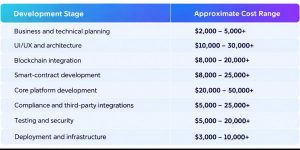
These are broad planning ranges. Actual pricing depends on the team, location, integrations, asset class, security requirements, and product scope.
RWA Platform Development Timeline
A focused RWA MVP can take around 3–4 months.
A more advanced platform can require 6–10 months or longer.
A typical development process may look like this:
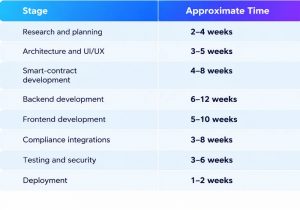
These phases can overlap, so the total project duration is not simply the sum of every stage.
Primary Issuance vs. Secondary Trading
A platform focused on primary issuance is much simpler than a platform that includes a secondary marketplace.
Primary issuance generally follows:
Issuer → Offering → Investor → Token
A secondary market introduces:
Investor A → Marketplace → Compliance → Settlement → Investor B
This creates additional requirements around:
- Investor eligibility
- Transfer restrictions
- Custody
- Settlement
- Pricing
- Liquidity
- Trading rules
- Regulatory controls
For this reason, businesses can often reduce initial RWA tokenization platform development costs by starting with primary issuance and adding secondary trading after the core platform has been validated.
Custom RWA Platform vs. White-Label Solution
Another important cost decision is whether to build from scratch or use existing infrastructure.
| Factor | Custom Development | White Label |
| Initial cost | Higher | Lower |
| Time to market | Longer | Faster |
| Customization | High | Limited to available options |
| Compliance customization | Higher flexibility | Depends on provider |
| Ownership | Greater control | Provider-dependent |
| Long-term flexibility | High | Moderate |
| Recurring fees | Usually lower after development | May include licensing fees |
White-label infrastructure can make sense when speed is the priority.
Custom development may be more suitable for businesses that want greater control over token logic, compliance workflows, integrations, investor experience, and future expansion.
How to Reduce RWA Tokenization Platform Development Cost
The goal should not be to build the cheapest platform possible.
The goal should be to build the smallest platform that can safely validate the business model. If you are planning to move from the idea stage to an actual RWA product, our guide on Launch Your Own RWA Tokenization Project explains the key steps involved in planning and launching an RWA tokenization project.
A practical first version could include:
- One asset class
- One blockchain
- Investor onboarding
- KYC integration
- Eligibility checks
- Token issuance
- Wallet functionality
- Portfolio management
- Basic reporting
- Essential compliance controls
Instead of building a complete secondary marketplace immediately, businesses can add it later.
Using established KYC providers, custody infrastructure, cloud services, blockchain APIs, and audited smart-contract components can also reduce the amount of infrastructure that needs to be built from scratch.
How WisewayTec Can Help Build an RWA Platform
An RWA platform requires more than token creation.
It needs a connected architecture across blockchain, smart contracts, wallets, compliance, asset management, investor applications, and supporting integrations.
WisewayTec can help businesses plan and develop blockchain components for RWA platforms, including smart contracts, token infrastructure, blockchain integration, wallet functionality, and the supporting Web3 application layer.
The right development approach starts by understanding the asset, legal structure, investor model, custody requirements, compliance needs, and blockchain architecture.
Final Thoughts
The hard part is bringing together the real-world asset, legal structure, investor needs, token standards, compliance standards, custody, smart contracts, and blockchain infrastructure into a single scalable, secure platform.
2026 Prototype development budget for 2026: A practical MVP can cost anywhere from $35k to $50k to $500k+ for an enterprise platform.
Cost: All-in Cost to use or deploy, which depends on what you are tokenizing, where you will work, who will be allowed to invest, which blockchain you will use, what token standard you need, to what degree compliance is required, and if you want secondary trading.
The easier method for most firms is to identify, starting with a single asset class, a single blockchain, a single clear investor journey, and the compliance infrastructure that goes with that use case.
Following validation of the model, the platform can scale to new asset classes, geographic jurisdictions, custody types, multi-chain integrations, and secondary markets.
We don’t want to tokenise everything on day 1.
Build the right foundation for the asset and investors you truly wish to target.
Frequently Asked Questions
How much does an RWA tokenization platform cost in 2026?
A focused RWA MVP will typically cost between $35,000 – $80,000, whereas a mid-level platform will start from $80,000 and go up to $200,000. At the enterprise level, solutions offering custody, compliance, multi-chain support, and marketplace services will cost more than $500,000 or even reach the million-dollar level.
Which token standard is best for RWA tokenization?
There is no one-size-fits-all answer. While ERC-20, ERC-721, and ERC-1155 standards can be utilized for different use cases, a permissioned standard such as ERC-3643 can provide additional benefits for regulated-use cases by centering compliance and identity-governed token transfers.
Does RWA tokenization require KYC and AML?
It varies by asset, market, legal form and investor model. Platforms dealing with regulated financial assets typically require proper investor classification and eligibility controls.
Which blockchain is best for RWA tokenization?
There are several options that can be considered as the best blockchain for RWA tokenization. Thus, Ethereum, Polygon, Arbitrum, Base, Solana, and many others are suitable for this kind of activity. All of them have their own advantages, such as transaction speeds, token standards, custody solutions, compliance infrastructure, ecosystem, and other investors’ needs.
Can an RWA platform have a secondary market?
Yes, but with secondary trading comes additional complications in relation to investor eligibility, transfer restrictions, custody, settlement, liquidity, pricing, and regulatory controls. For many businesses, it will be preferable to initially focus on primary issuance.