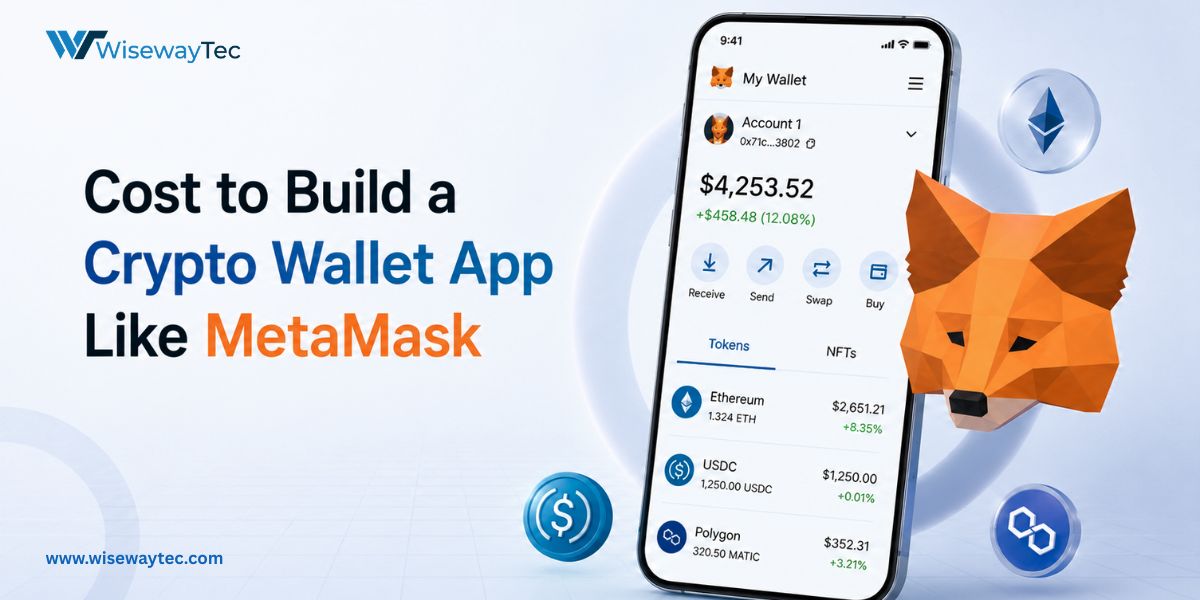
The global crypto wallet market is booming, with over 84 million blockchain wallet users worldwide and a market projected to exceed $48 billion by 2030. MetaMask, the browser-based and mobile Ethereum wallet, has set the standard for a modern crypto wallet.
For startup founders, blockchain entrepreneurs, and enterprise teams, the key question is not whether to invest in Crypto Wallet App Development but how to budget for it and build it well. Whether you are building a MetaMask alternative, a DeFi-focused wallet, or a full-service multi-chain solution, understanding the true cost drivers behind development is essential before committing capital and resources. This guide breaks down those costs so you can make a clearer decision.
This guide strips away the guesswork. You will find a granular cost breakdown, detailed feature analysis, development timelines, and expert strategies to maximise your ROI—all grounded in real-world blockchain development experience.
What Is MetaMask and Why Is It So Popular?
MetaMask, launched in 2016 by ConsenSys, is the world’s most widely adopted non-custodial crypto wallet. It functions as a browser extension and mobile application, enabling users to interact seamlessly with Ethereum and EVM-compatible blockchain networks. As of 2024, MetaMask boasts over 30 million monthly active users across 170+ countries.
What makes MetaMask the benchmark for crypto wallet app development?
- Non-custodial architecture — Users retain full ownership of private keys and funds
- Multi-network support — Ethereum, Polygon, BNB Chain, Avalanche, Arbitrum, and more
- Built-in token swap — Aggregates DEX liquidity for best-rate token exchanges
- NFT and dApp integration — Seamless access to the full Web3 ecosystem
- Open-source codebase — Transparent, auditable, and community-trusted
- Browser + mobile parity — Chrome, Firefox, Brave, iOS, and Android
MetaMask didn’t succeed just because it was the first one out. It succeeded because it solved a real problem simply and elegantly. It gave regular people a safe way to get into Web3 without overcomplicating it.
Now, any company that wants to make a serious crypto wallet app has to compare itself to MetaMask’s standard. They have to ask themselves, “Can we make something that’s just as easy to use and just as secure?” That’s the benchmark now.
Key Features of a Crypto Wallet App Like MetaMask
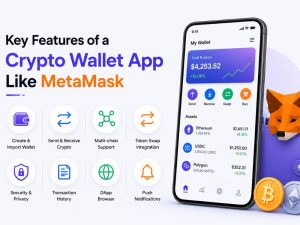
1. User Registration and Authentication
A secure authentication system protects user accounts from unauthorized access.
Features include:
- Biometric authentication
- PIN protection
- Two-factor authentication
- Multi-device login support
2. Multi-Currency Wallet Support
Users expect support for multiple cryptocurrencies, including:
- Bitcoin (BTC)
- Ethereum (ETH)
- USDT
- BNB
- Polygon
- Solana
3. Private Key Management
Secure private key storage is one of the most important wallet functionalities.
Options include:
- Local device storage
- Encrypted storage
- Hardware wallet integration
4. Wallet Backup and Recovery
Recovery phrases help users regain access if devices are lost.
Essential features:
- Seed phrase generation
- Backup reminders
- Recovery verification
5. Token Swap Functionality
Integrated token swaps improve convenience and user engagement.
Benefits include:
- Instant asset exchanges
- Better liquidity access
- Reduced user friction
6. NFT Management
NFT support has become a standard feature in modern crypto wallets.
Capabilities include:
- NFT viewing
- NFT transfers
- Collection management
7. Multi-Chain Compatibility
Supporting multiple blockchain networks attracts a broader audience.
Popular networks:
- Ethereum
- BNB Chain
- Polygon
- Avalanche
- Arbitrum
- Optimism
8. Real-Time Market Data
Providing live price updates helps users monitor portfolio performance.
Features include:
- Portfolio tracking
- Price alerts
- Market trends
9. Push Notifications
Users receive instant updates regarding:
- Transactions
- Price movements
- Security alerts
10. Advanced Security Features
Security remains the highest priority in crypto wallet app development.
Security measures include the following:
- End-to-end encryption
- Multi-factor authentication
- Anti-phishing protection
- Session management
- Secure key storage
Factors Affecting Crypto Wallet App Development Cost
No two crypto wallet projects will have the same price tag. In fact, ten factors basically determine how much your final development budget will be:
1. App Complexity: A simple wallet costs less than a feature-rich wallet with NFT support, DeFi integration, and multi-chain functionality.
2. Platform Choice: Developing for multiple platforms such as iOS, Android, web, and desktop increases overall development costs.
3. Blockchain Network Integration: Supporting multiple blockchains requires additional development, testing, and infrastructure setup.
4. UI/UX Design: Custom designs, animations, accessibility features, and user testing can increase project costs.
5. Security Requirements: Advanced security measures such as encryption, MFA, and security audits require additional investment.
6. Smart Contract Development: Custom smart contracts for staking, tokens, and DeFi features add to the development budget.
7. Third-Party API Integrations: Integrating APIs, payment gateways, and fiat on-ramp services increases complexity and costs.
8. Testing & Quality Assurance: Comprehensive testing ensures performance, security, and compatibility across devices and networks.
9. Compliance Requirements: AML, KYC, GDPR, and regulatory compliance can significantly impact development expenses.
10. Development Team Location: Hourly rates vary by region, making team location a major factor in overall project cost.
Cost Breakdown of Crypto Wallet App Development
The table below reflects real-world estimates based on building a MetaMask-level crypto wallet from scratch with a professional development team:
| Feature / Component | Estimated Cost Range (USD) | Development Time |
| Project Discovery & Architecture | $3,000 – $8,000 | 1–2 weeks |
| UI/UX Design (Mobile + Web) | $8,000 – $20,000 | 3–5 weeks |
| User Auth & Onboarding | $5,000 – $10,000 | 2–3 weeks |
| Wallet Core (Key Gen, Storage) | $10,000 – $20,000 | 3–5 weeks |
| Multi-Chain Integration (3–5 chains) | $15,000 – $35,000 | 4–8 weeks |
| Token Swap (DEX Aggregator) | $12,000 – $25,000 | 3–5 weeks |
| NFT Support & Gallery | $8,000 – $18,000 | 2–4 weeks |
| dApp Browser / WalletConnect | $8,000 – $15,000 | 2–3 weeks |
| Real-Time Market Data & Portfolio | $5,000 – $12,000 | 2–3 weeks |
| Push Notifications | $3,000 – $7,000 | 1–2 weeks |
| Security Implementation | $10,000 – $30,000 | 2–5 weeks |
| Smart Contract Development | $10,000 – $30,000 | 3–6 weeks |
| QA & Testing | $10,000 – $20,000 | 3–5 weeks |
| Deployment & DevOps Setup | $5,000 – $10,000 | 1–2 weeks |
| Post-Launch Support (3 months) | $5,000 – $15,000 | Ongoing |
| TOTAL (MVP Wallet) | $80,000 – $150,000 | 6–9 months |
| TOTAL (Full-Featured Wallet) | $150,000 – $300,000+ | 9–18 months |
Note: MVP wallets with 1–2 chain support, basic send/receive, and minimal UI can be built in the $40,000–$80,000 range. Costs above reflect production-grade, security-audited, and fully featured wallet applications.
Development Stages and Timeline
A professional crypto wallet app development engagement follows a structured lifecycle. Here’s a breakdown of each phase:
Phase 1: Discovery & Planning (Weeks 1–2)
Define your target audience, blockchain networks, feature set, and compliance requirements. Produce a technical specification document and project roadmap. This phase prevents costly scope changes downstream.
Phase 2: UI/UX Design (Weeks 3–7)
Wireframes, interactive prototypes, and final UI kit development. User testing with a target group of crypto-native testers. Dark mode, accessibility, and responsive design are finalised here.
Phase 3: Core Development (Weeks 8–22)
Backend infrastructure, blockchain node integration, wallet key management, smart contract development, and API integrations are built in parallel sprints. Frontend development (React Native mobile + React web extension) runs concurrently.
Phase 4: Security Implementation (Weeks 18–24)
End-to-end encryption, HSM/TEE integration for key storage on mobile, phishing protection, a transaction simulation engine, and third-party penetration testing. Smart contract audit by a recognised firm (CertiK, Trail of Bits, OpenZeppelin).
Phase 5: QA & Testing (Weeks 22–28)
Functional testing, smart contract test suite (Hardhat/Foundry), testnet transaction validation across all supported chains, performance testing, and security regression testing.
Phase 6: Deployment (Weeks 28–30)
App store submissions (iOS App Store, Google Play), Chrome Web Store submission, CI/CD pipeline setup, monitoring dashboards, and staged rollout to beta users.
Phase 7: Maintenance & Iteration
Post-launch support covering bug fixes, new blockchain integrations, protocol upgrades, security patches, and feature roadmap execution. Budget 15–20% of the build cost annually for maintenance.
How to Reduce Crypto Wallet App Development Costs
Smart founders maximise value without cutting corners on security. Here are proven strategies:
- Start with an MVP — Launch with 1–2 chains, core send/receive, and basic swap. Validate market fit before building the full feature suite.
- Choose a reputable offshore development partner—Eastern European or South Asian blockchain agencies often deliver equivalent quality at 40–60% lower cost than US firms.
- Leverage open-source libraries—Web3.js, Ethers.js, WalletConnect SDK, and Wagmi save thousands of development hours.
- Use managed node services — Alchemy, Infura, and QuickNode eliminate the need to run your own blockchain infrastructure.
- Use React Native for mobile app development – A single codebase can be used for both iOS and Android, helping businesses reduce development costs and speed up the launch process.
- Reuse audited smart contracts — OpenZeppelin’s library provides battle-tested contract templates. Don’t rewrite what is already secure and proven.
- Parallel track design and development — Prevent timeline delays by running UI design and backend development concurrently.
- Prioritise scope ruthlessly—Every feature added mid-development costs 3x what it would have in planning. Lock the scope before coding begins.
Why Businesses Choose Custom Crypto Wallet App Development
While white-label solutions offer faster deployment, custom development provides the following:
- Unique branding
- Better scalability
- Greater flexibility
- Enhanced security controls
- Improved user experience
- Long-term competitive advantages
A custom wallet allows businesses to create tailored experiences that align with their business goals.
Future Trends in Crypto Wallet App Development
The next generation of crypto wallet apps will be fundamentally different from today’s tools. Builders who understand these trends now will have a significant competitive advantage:
Account Abstraction
Simplifies user onboarding by reducing wallet complexity.
MPC Wallets
Multi-Party Computation technology enhances security by eliminating single points of failure.
AI-Powered Security
Artificial intelligence can detect suspicious activities and fraud patterns in real time.
Web3 Ecosystem Integration
Future wallets will provide deeper connectivity with decentralized applications and services.
Cross-Chain Transactions
Users increasingly demand seamless interactions across multiple blockchain networks.
Why Choose WisewayTec for Crypto Wallet App Development
WisewayTec specialises in delivering secure and scalable blockchain solutions tailored to modern business requirements.
Our expertise includes:
- Custom crypto wallet development
- Multi-chain wallet integration
- Advanced security implementation
- Smart contract development
- Web3 application development
- Ongoing maintenance and support
With a focus on innovation, security, and user experience, WisewayTec helps businesses launch next-generation cryptocurrency wallet solutions.
Ready to Build a Secure Crypto Wallet App Like MetaMask? |
Thinking about building a crypto wallet app? Whether you’re a startup with a new idea or a business looking to expand into Web3, WisewayTec can help turn your vision into a secure and easy-to-use product.
Contact WisewayTec today for a FREE consultation and detailed project estimate. Let’s turn your vision into the next great crypto wallet.
Conclusion
The cost to build a crypto wallet app like MetaMask depends on various factors, including features, security requirements, blockchain integrations, and platform compatibility. While development costs can range from $30,000 to over $250,000, the investment can deliver significant long-term value for businesses entering the blockchain space.
If you’re planning to enter the blockchain industry, partnering with WisewayTec can help you build a reliable and secure wallet app designed for today’s users and tomorrow’s opportunities.
Frequently Asked Questions
1. How much does crypto wallet app development cost?
The cost typically ranges from $30,000 to $250,000+, depending on complexity, features, and blockchain integrations.
2. How long does it take to develop a crypto wallet app like MetaMask?
Development usually takes between 4 and 8 months based on project scope and customisation requirements.
3. What are the essential features of a crypto wallet app?
Key features include private key management, multi-currency support, wallet recovery, token swaps, NFT support, and strong security measures.
4. Is custom crypto wallet development better than white-label solutions?
Custom development offers greater flexibility, branding opportunities, scalability, and enhanced security.
5. Why choose WisewayTec for crypto wallet app development?
WisewayTec provides end-to-end blockchain development services, including wallet development, security implementation, multi-chain support, and ongoing technical assistance.