More than 13 million crypto tokens have been created across public blockchains, yet only a tiny fraction have achieved meaningful adoption. The reason isn’t a lack of technology; it’s a lack of utility. Too many projects launch tokens before answering the most important question: Why would anyone continue using this token after the initial hype fades?
In 2026, investors, users, and regulators are looking beyond whitepapers and marketing campaigns. They want products that solve real problems, sustainable tokenomics that reward participation, and ecosystems where the token plays an essential role. A token without utility may generate short-term attention, but it rarely creates long-term value.
Whether you’re building a Web3 startup, an AI-powered platform, a DeFi protocol, or an enterprise blockchain solution, success begins with designing a token that people actually need—not one they simply speculate on. This guide walks you through every stage of creating a utility-driven token, from validating your idea and designing tokenomics to choosing the right blockchain, building security, and creating long-term ecosystem growth.
Why Most Crypto Tokens Fail
Most tokens fail because they were never solving a problem in the first place. They were solving a fundraising problem, or an attention problem, and once the raise was done or the attention moved on, there was nothing left to hold demand up.
Three patterns show up again and again in failed launches:
- The token shipped before the product. Teams raise capital and generate liquidity through the token, then try to build the actual product with what’s left. Once early hype fades, there’s no mechanism pulling in new buyers.
- Marketing got mistaken for product-market fit. A large Discord, an active X account, and a few influencer posts can make a project look alive while nobody is actually using it for anything beyond trading.
- Emissions outran demand. Reward tokens got printed faster than real usage could absorb them, so the token price bled out regardless of how the roadmap looked.
The 2025 failure wave was accelerated by permissionless launchpads that let anyone deploy a token in minutes with no development behind it, but the underlying lesson predates that trend. Projects with genuine revenue, active development, and product-market fit before the token existed have survived at dramatically higher rates than projects that launched a token as their first move. If you’re evaluating a crypto token development company or planning a launch yourself, this is the single most important filter: is the token funding real usage, or is it a substitute for it?
What Does “Token Utility” Actually Mean?
Token utility is the specific, ongoing function a token performs inside a product or network-something that gives someone a reason to hold or use it other than expecting the price to go up.
In plain terms, a token has utility when it does at least one of the following:
- Grants access — to a feature, a service tier, an API, or a marketplace.
- Pays for something real — compute, storage, bandwidth, transaction fees, or in-game items.
- Shows a demand for a product – the possession of a physical product, a fraction of budgetary income, or a claim to an allowance.
- Organises action – staking to protect a network, casting votes for protocol changes, or collecting prizes for legitimate labour (e.g., operating a node or providing information).
- Reduces friction — settling payments faster or cheaper than the alternative it replaces.
A token without utility is priced entirely on narrative and supply/demand from traders. That’s not automatically worthless — some meme tokens sustain communities for years — but it’s a fundamentally different business than building a product. If your pitch deck describes the token before it describes the problem, that’s a signal worth pausing on.
Why Utility Matters in Crypto Token Development
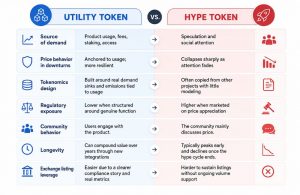
Hype-driven demand is reflexive: price goes up because people expect it to keep going up, and it collapses the moment that expectation breaks. Utility-driven demand is structural: people need the token to do something, so demand persists even when sentiment is flat or negative.
This shows up clearly in how tokens behave during downturns. Tokens tied to actual usage — transaction fees, staking for network security, payment for compute or storage — tend to have demand anchored to usage volume, not just trading volume. When a network processes more transactions, more of its token gets used regardless of what traders think about the market that week. That’s the core argument for utility-first design: it turns a token from a speculative bet into an operating component of a business, which is a far more durable source of demand.
It also compounds. Every new integration, every new use case added to a utility token, adds another reason to hold it. A hype token has no equivalent compounding mechanism — its only lever is attention, and attention decays fast.
Does Your Business Even Need a Token?
This is the question most founders skip, and it’s the one a serious Token Development Company should ask first — even if the answer costs them a project.
Ask these questions honestly before writing a single line of tokenomics:
- Can a database do this instead? If your “token” is really just a points system or a loyalty ledger, you don’t need a blockchain, let alone a tradable asset.
- Does the token need to move value between parties who don’t trust each other? If all activity happens inside your own platform between you and your users, a token adds complexity without adding function.
- Would the network work better with more independent participants? Tokens are strongest when they coordinate people who don’t already have a business relationship — node operators, liquidity providers, contributors, or a distributed marketplace.
- Is there a real, recurring reason to hold or use the token beyond speculation? If you can’t answer this in one sentence without using the word “reward,” rethink it.
- Could regulation classify this as a security? If the token’s value is expected to come mainly from the efforts of your team, that changes your legal obligations significantly (see the Compliance section).
If you answer “no” to most of these, you likely need a product, a loyalty program, or an equity structure — not a token. A blunt answer here early saves months of wasted tokenomics design and legal exposure later.
Utility-First Tokenomics
Tokenomics is the economic design of a token: how many exist, who gets them, how new supply enters circulation, and what demand pulls it out again. Utility-first tokenomics starts from the use case and builds the numbers around it — not the other way around.
Core elements to design deliberately
- Supply model: Fixed, inflationary, or deflationary—chosen based on what the token needs to incentivise, not what looks good on a chart.
- Allocations: Team, investors, ecosystem, treasury, community allocations, all with vesting schedules longer than it takes to provide liquidity for investors looking for an exit in a few months-long enough for multi-year development, not short-term cash-in.
- Utility Mechanisms: Everything one actually does with the token – pay fees, stake, pay into a tier, and claim for a service – is the most important component.
- Demand sinks: Mechanisms that remove tokens from circulation or lock them up, such as staking requirements, burns tied to usage, or fee payments.
- Emission schedule: Reward rates that scale with real usage rather than a fixed calendar, so you’re not paying out incentives faster than the network is growing.
A simple framing for founders
Every utility token needs a clear answer to one question: “What breaks if this token didn’t exist?” If the honest answer is “nothing, we’d just use USDC or a normal database,” the tokenomics model needs rethinking before launch, not after.
Governance: Giving Token Holders Real Say
Governance tokens allow users to vote for decisions on the protocol like adjusting fees, using the treasury, protocol upgrades, or even protocol integrations. Done correctly, governance gives users a stake in the system so that they have a legitimate reason to remain active. Otherwise, governance is nothing but superficial voting where the outcome is pre-determined.
Practical guardrails worth building in from day one:
- Quorum (participation requirement) and proposal requirement thresholds that block neither paralysis nor small, large holder capture.
- Timelocks on accepted changes so the community can act to halt execution if desired before code is deployed live.
- Delegated voting such that a person can combine their vote with those of smaller holders and delegate decision-making to someone they trust, rather than having to scrutinise every proposal.
- Transparent treasury reporting, since governance without visibility into what’s actually being voted on is governance in name only.
Governance rights are also a utility in their own right — they give holders a functional reason to keep tokens beyond price speculation, which supports the long-term demand argument above.
Smart Contract Security
A utility token is only as trustworthy as the smart contract that issues and manages it. Security failures — exploited bridges, reentrancy bugs, unlimited minting functions left in by mistake — have wiped out more token value than most bear markets combined.
Baseline practices that any serious blockchain development process should include:
- Independent audits from more than one reputable security firm before mainnet launch, and again after any major upgrade.
- Formal verification for critical logic, especially anything touching minting, burning, or treasury functions.
- Bug bounty programs that stay active permanently, not just around launch.
- Multi-signature and timelocked controls for admins – not just one individual could wipe out a treasury or immediately alter critical configurations.
- Testnet deployment and “simulate an attack” in this environment prior to any live funds being entered.
- Open-source, verified contract code on the deploying chain’s block explorer, so anyone can independently confirm what the contract actually does.
None of this guarantees a flawless launch, but skipping it is how avoidable exploits become front-page news.
Compliance Considerations
Regulatory treatment of tokens varies by jurisdiction and depends heavily on how the token is structured and marketed — this is not legal advice, and any real project needs qualified counsel. That said, a few principles apply broadly enough to plan around:
- Function matters more than branding. Regulators generally look at whether token value depends primarily on the effort of a central team (which points toward security-like treatment) versus whether it’s consumed for a genuine product or network function.
- Marketing language creates risk. Promising price appreciation, “guaranteed returns,” or framing a token primarily as an investment opportunity increases regulatory exposure regardless of the underlying tech.
- Dominant markets are moving towards clearer frameworks. The EU (via MiCA) and the US have been releasing clearer regulations on token issuance, stablecoins and listing on exchanges in a step-by-step manner, until 2026, thus increasing the costs of compliance but creating a less uncertain environment compared to the one that “killed” many previous projects.
- KYC/AML obligations increasingly apply to token sales, exchange listings, and sometimes even certain DeFi front ends, depending on jurisdiction.
- Tax treatment of token rewards, staking income, and governance participation differs by country and should be documented clearly for your community, not left ambiguous.
Projects that treat compliance as a design input from day one — rather than a problem to solve after a regulator asks questions — consistently have an easier path to exchange listings, institutional partnerships, and long-term survival.
Community Building That Isn’t Just Marketing
A community that only shows up to talk price is not a community — it’s a chatroom. Real community building around a utility token centres on getting people to use the thing, not just hold it.
What actually works:
- Give early users a functional role, not just a Discord badge — beta access, node operation, content moderation, or protocol testing.
- Reward contribution, not just presence. Bounties for documentation, integrations, or bug reports build a community that adds value back into the product.
- Publish openly and regularly. Constant disclosure of tech progress, financial disclosures, and transparent communication of obstacles will ultimately create a great deal of belief and trust rather than only making announcements that cover up weaknesses and failures.
- Let the product speak before the token does. Communities built around genuine usage tend to be far stickier through market downturns than communities built around price talk alone.
Exchange Listing Strategy
Getting listed is not the finish line — it’s a distribution channel, and it should be treated as one step in a longer plan rather than the goal itself.
- Start with liquidity, not prestige. A well-funded liquidity pool on a reputable DEX often does more for real users than a rushed centralized exchange (CEX) listing with thin order books.
- Match the exchange to your user base. A DePIN or enterprise token may get more value from listings on exchanges with strong institutional access than one optimized purely for retail volume.
- Prepare documentation in advance. Most reputable exchanges require audited contracts, clear tokenomics disclosures, and legal opinions before listing — building these during development, not the week before applying, saves months.
- Plan market-making, not just listing. A token that lists with no market-making support often shows extreme volatility that scares off exactly the long-term holders you want.
Post-Launch Growth
Launch day is the beginning of the token’s life, not the end of the work. Utility tokens that keep growing after launch typically share a few habits:
- Usage-linked metrics over price metrics. Tracking active wallets, transaction volume tied to the token’s actual function, and integration count tells you far more about health than the chart does.
- Continuous integrations. Every new partner, chain, or use case added after launch is a new demand source — this is where utility-first design pays off long term.
- Emission modifications to respond. When usage statistics indicate that there is more reward than demand, make necessary emissions adjustments before it’s too late.
- Continuous security assessments, rather than a one-time security assessment seen as a guarantee for all time.
Common Mistakes Founders Should Avoid
Even experienced entrepreneurs can make decisions that limit a token’s long-term success.
Avoid these common pitfalls:
Launching Without a Product
Lacking a working product at launch can create an erosion of community trust.
First, focus on creating a working platform before making the community invest in your ecosystem.
Bad Tokenomics
Problems with the design of token distribution, bad inflation rates, or unreal rewards can destroy trust fast.
Create tokenomics for future growth.
Copying Other Projects
What works for one ecosystem may not work for another.
Build utility around your own business model instead of replicating another project’s token design.
Security Risks
One smart contract bug could ruin your reputation forever.
Make security checks, testing, and audits your top priorities.
Only Considering Listings
There are many people who think that listing their token on exchanges will make them successful.
It does improve visibility, but it won’t substitute for quality and actual users.
Real-World Utility Token Examples
Several blockchain projects demonstrate how real utility drives adoption.
Ethereum (ETH)
ETH powers the Ethereum network by enabling transaction fees, smart contract execution, staking, and decentralized applications.
Without ETH, the Ethereum ecosystem cannot function.
Chainlink (LINK)
LINK is used to pay decentralized oracle operators who deliver reliable real-world data to blockchain applications.
Its value comes directly from network usage rather than speculation alone.
BNB
Originally introduced to reduce trading fees on Binance, BNB has evolved into a utility token supporting payments, staking, decentralized applications, and blockchain infrastructure.
Its expanding use cases have contributed to long-term adoption.
These examples share one important characteristic:
People use the token because they need it—not simply because they expect its price to increase.
Token Utility Trends Shaping 2026
The blockchain industry is evolving rapidly, and token utility is becoming more sophisticated.
Here are several trends founders should watch:
AI-Powered Blockchain Applications: AI agents, automated workflows, and decentralised AI marketplaces increasingly use tokens for payments, governance, and service access.
Real-World Asset (RWA) Tokenization: Companies are applying tokenisation to various kinds of assets, including real estate, commodities, invoices, and instruments, to create better conditions of liquidity and accessibility.
DePIN (Decentralized Physical Infrastructure Networks): Projects are rewarding users for contributing computing power, storage, connectivity, and other physical infrastructure.
Enterprise Blockchain: Organizations are using blockchain to improve supply chain management, identity verification, and secure data sharing, with utility tokens supporting ecosystem participation.
Cross-Chain Ecosystems: Modern projects increasingly support multiple blockchains, allowing users to move assets and interact across different networks without friction.
Utility Token vs. Hype Token: Comparison Table
Key Takeaways
- More than half of all tokens launched since 2021 have failed, and most of those failures happened in a single recent year — largely because tokens were treated as a fundraising or attention tool rather than a functional part of a product.
- Token utility refers to the specific purpose for which the token is used: buying something valuable, providing access, granting a right to value, or coordinating network participants.
- Not all businesses need a token. An easy test will show it in just a few minutes.
- Tokenomics, governance, security, and compliance should all be designed around the token’s actual function, not copied from other projects.
- In 2026, the strongest-performing token categories — AI, RWA, DePIN, GameFi, DeFi, and enterprise blockchain — are all rewarding tokens tied to measurable usage over tokens tied only to narrative.
- Working with an experienced Token Development Company early — before tokenomics are locked in — meaningfully improves the odds of building something that lasts past the first hype cycle.
Conclusion
Hype can get a token listed. It can’t keep it alive. The tokens still standing years after launch are the ones doing real work — paying for compute, securing a network, settling a real-world asset, or giving holders a functional reason to stay involved. Everything else is a bet on attention, and attention is the least reliable resource in crypto.
If you’re planning a token launch in 2026, the highest-leverage decision you’ll make isn’t your listing strategy or your marketing budget — it’s whether the token has a real job to do before you write a single line of tokenomics. That’s the question WisewayTec starts every engagement with. As a Token Development Company, WisewayTec works with founders on utility-first tokenomics, secure smart contract development, governance design, and compliance-aware launches — across DeFi, RWA, DePIN, GameFi, and AI-driven use cases — so the token you build is one people still need to use a year from now, not just one they traded once
Frequently Asked Questions
1. What is a utility token?
A utility token provides access to products, services, or features within a blockchain ecosystem. Unlike speculative tokens, it has a practical purpose that encourages ongoing use.
2. Do all blockchain projects need a token?
No. A token should only be created if it adds measurable value to the platform and improves the user experience.
3. How can I increase demand for my crypto token?
Don’t put all your effort into marketing; instead, increase your token’s utility through features, staking, governance, etc.
4. Which blockchain is best for creating a utility token?
It is contingent upon your project and what you’re trying to accomplish. There’s no one answer to that question. You can look at Ethereum, Solana, Polygon, BNB Chain, Avalanche.
5. Why do many crypto tokens fail?
Bad tokenomics, no use case in the real world, weak security, unrealistic marketing strategies and lack of product adoption.