Crypto exchanges had their moment. They rewired how people thought about money, ownership, and speculation. But a quieter revolution is gaining serious momentum — and it might just be bigger. Prediction markets are no longer a niche curiosity for economists and political junkies. As adoption accelerates, businesses are increasingly exploring how a reliable prediction market development company can help build scalable and secure forecasting platforms for real-world use cases.
Prediction markets have become a real-time intelligence layer on top of the global economy. And the numbers are starting to prove it.
What is Prediction Markets, and How it Works?
The fundamental concept behind prediction markets is to provide an arena for individuals to buy and sell contracts that have a basis of the outcome of a predictably uncertain future occurrence or event. They operate in the same way as a stock market, with the transactions involving contracts that reflect the likelihood of certain events happening, such as the election of a political candidate or the extent to which inflation will reach a predetermined level, as well as the ability to accurately predict the release of a new product by a major technology firm by a specified date.
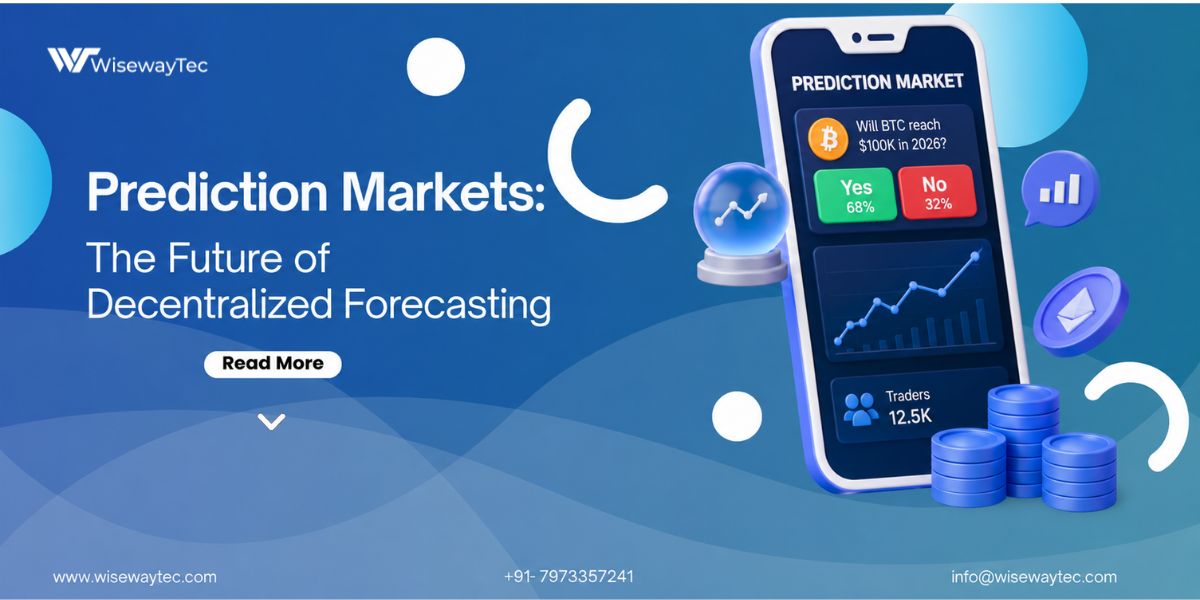
Each contract price represents a market’s aggregate or collective assessment of the likelihood of any of the above events occurring. If a contract trading at $0.68 represents “Candidate X wins,” the market is implying a 68% probability of that outcome. Simple, elegant, and surprisingly accurate.
Prediction markets aggregate the “wisdom of the crowd” — pulling dispersed knowledge from thousands of participants into a single, digestible probability signal. Research from Oxford and Harvard has repeatedly shown that they outperform traditional polling and expert forecasting.
As demand grows, many businesses are now investing in prediction market platform development to build forecasting ecosystems powered by blockchain and smart contracts.
How Prediction Markets Actually Work
The Mechanics Behind the Market
A prediction market opens with a clearly defined question and a resolution date. Traders buy YES or NO contracts, while supply and demand continuously adjust the market price. Once the event resolves, an oracle or platform rule confirms the outcome, and winning contracts pay out at exactly $1.
- Contracts are typically priced between $0.01 and $0.99, representing a 1–99% probability
- Traders can exit positions early, locking in gains or limiting losses before the event resolves
- Market makers provide liquidity and help keep spreads tight on active contracts
- Decentralized platforms use smart contracts and oracles to automate settlements and payouts
- Centralized platforms operate under regulatory frameworks similar to traditional futures exchanges
The rapid rise of blockchain prediction markets is also driving innovation in decentralized finance and event-based trading infrastructure.
Centralized vs Decentralized Platforms
Much like crypto, prediction markets come in two flavours.
Centralized platforms — like Kalshi or PredictIt — are regulated and easier to use. Decentralized platforms — like Polymarket — run on blockchain infrastructure, offering global access without a central authority taking custody of funds.
This growing demand is creating new opportunities for every prediction market development company focused on smart contract architecture, decentralized applications, and event-driven trading systems.
Prediction Markets vs Crypto Exchanges: The Key Differences
| Prediction Markets | Crypto Exchanges | |
| What you trade | Outcome probabilities | Digital tokens/assets |
| Price meaning | Probability of an event | Speculative supply/demand |
| Resolution | Binary — clear end date | Open-ended, no resolution |
| Real-world utility | Hedging, forecasting, intelligence | Mostly speculative or transactional |
| Regulation (US) | Kalshi CFTC-approved (2023) | Ongoing legal uncertainty |
| Institutional appeal | Growing rapidly | Present but cautious |
The difference that matters most: crypto exchanges trade assets. Prediction markets trade information. That distinction defines their long-term potential audience.
Five Reasons Prediction Markets Could Outgrow Crypto
1. They Have Utility Beyond Pure Speculation
Crypto’s biggest persistent criticism is: what is it actually for? Outside of Bitcoin as digital gold and stablecoins as payment rails, most tokens struggle to answer that question convincingly.
Prediction markets sidestep the problem entirely. A corporate risk manager can hedge against regulatory outcomes. An insurer can price climate-related policies. A political consultancy can track live probability shifts on legislation. The utility is immediately legible — and it attracts serious money.
2. The Forecasting Track Record Is Compelling
During the 2024 US presidential election, Polymarket contracts shifted decisively toward Donald Trump hours before major media called the race — absorbing information the traditional forecasting world was slow to price in.
That kind of real-time accuracy builds institutional credibility fast.
| $1B+
Polymarket volume in the week of the 2024 US election alone |
74%
Prediction market accuracy vs ~54% for expert panels in aggregated studies* |
$73B+
Estimated global prediction market size in 2023, growing at 10%+ CAGR |
3. Regulatory Clarity Is Arriving — and It Favors Prediction Markets
In 2023, the CFTC granted Kalshi the legal right to offer event contracts in the United States. That was a significant moment.
Crypto regulation remains fragmented across jurisdictions. Prediction markets tied to economic and financial events are finding a much cleaner regulatory path.
This regulatory progress is encouraging more investment into prediction market software development and institutional-grade forecasting platforms.
4. The Total Addressable Market Is Enormous — and Mostly Untouched
Prediction market infrastructure naturally serves adjacent industries that dwarf crypto’s current footprint:
- Insurance
- Enterprise risk management
- Political intelligence
- Supply chain forecasting
- Economic modeling
These are institutional markets with real operational demand for accurate forecasting systems.
As adoption grows, demand for prediction market app development and scalable event-trading infrastructure is expected to rise significantly.
5. Blockchain Makes Them Global and Trustless
Decentralized prediction markets inherit crypto’s most valuable innovation: eliminating counterparty risk.
Smart contracts hold funds, oracles confirm outcomes, and payouts execute automatically. No exchange can front-run you, freeze withdrawals, or quietly adjust the rules.
For institutional participants who watched major crypto failures unfold, trustless settlement is becoming a requirement rather than just a buzzword.
The combination of real-world event resolution, blockchain-based settlement, and regulatory legitimacy is positioning decentralized development platforms as a key pillar of next-generation financial infrastructure.
Real-World Use Cases Driving Adoption Right Now
Political & Economic Forecasting
Hedge funds and political consultancies increasingly monitor prediction market data alongside traditional polling. The signal is often cleaner because traders have financial skin in the game.
Corporate Decision-Making
Companies are running internal prediction markets to improve forecasting accuracy on product launches, revenue targets, and supply chain disruptions.
Many enterprises now partner with a prediction market development company to build customized internal forecasting systems for operational planning and business intelligence.
Research by Google, Microsoft, and HP has shown internal markets can outperform traditional top-down forecasting methods.
Risk Hedging
A business that relies on regulatory approval for a new product line can buy “NO” contracts on that regulation passing — effectively hedging business risk.
This is where prediction market platform development becomes valuable for institutional finance and enterprise risk management.
Sports and Entertainment
High-volume sports prediction markets demonstrate something important: mainstream users are comfortable with the format.
The learning curve is lower than crypto because users do not need deep knowledge of wallets, tokenomics, or blockchain mechanics.
Risks and Limitations You Should Know About
No emerging market is without friction. Prediction markets are genuinely exciting, but a balanced view matters.
- Liquidity constraints: Many niche markets have thin order books, making large positions difficult to execute without moving prices significantly
- Oracle risk: Decentralized markets rely on external data feeds to confirm outcomes — if the oracle is compromised or ambiguous, resolution disputes arise
- Regulatory patchwork: While the US is making progress, many jurisdictions still treat prediction markets as gambling, limiting global access
- Manipulation risk in low-volume markets: Small markets with few participants are easier to manipulate than deep liquid ones
- Complexity of outcome definitions: Poorly defined questions lead to interpretation disputes at resolution — a trust-destroying experience for new users
These are solvable problems. The crypto ecosystem faced identical challenges in 2015 — and solved most of them through infrastructure improvements and regulatory engagement.
Key Takeaways
- Prediction markets transform uncertainty into tradeable probability signals backed by financial incentives.
- Unlike crypto exchanges, prediction markets provide immediate utility for forecasting, risk management, and decision-making.
- Institutional adoption is growing because these platforms deliver real-time market intelligence.
- Regulatory clarity is improving, especially in the United States.
- Blockchain infrastructure is helping decentralized prediction markets scale globally.
- Demand for prediction market development companies and event-driven forecasting platforms is expected to grow alongside adoption.
Conclusion
Crypto exchanges changed how people viewed financial infrastructure. Prediction markets are doing something potentially even more impactful — creating a live probability engine for the world’s most important questions.
The direction is becoming difficult to ignore. Better infrastructure, growing institutional participation, improved regulation, and stronger forecasting accuracy are creating momentum across the industry.
For businesses exploring this opportunity, choosing the right prediction market will play a major role in scalability, platform security, liquidity design, and long-term growth.
If you want to explore scalable prediction market platform development solutions and blockchain-based forecasting systems
Explore Prediction Market Insights at Wisewaytec ↗
Frequently Asked Questions
Why are prediction markets becoming popular?
Prediction markets allow users to trade on real-world outcomes while generating probability-based insights. Their ability to aggregate crowd intelligence often makes them more accurate than traditional forecasting models.
Why are prediction markets considered accurate?
Prediction markets work because participants have financial incentives tied to outcomes. This creates stronger information efficiency compared to opinion-based polling systems.
What does a prediction market development company do?
A prediction market development company builds platforms where users can trade contracts based on future event outcomes. Services often include blockchain integration, smart contract development, liquidity systems, oracle integration, and decentralized application architecture.
How are blockchain prediction markets built?
Blockchain prediction markets typically use smart contracts, decentralized settlement systems, oracle networks, and tokenized event contracts to enable secure forecasting ecosystems.
How can Wisewaytec help me get started with prediction markets?
If you’re new to prediction markets, Wisewaytec is a solid first stop. The platform is designed to make sense of a space that can feel overwhelming at first — tracking live contract prices, explaining what probability shifts actually mean, and helping you spot opportunities across both centralized platforms like Kalshi and decentralized ones like Polymarket. Think of it as your research layer before you place a trade.