Building a cryptocurrency exchange in 2026 requires much more than developing a trading platform. Depending on your business model, the development cost typically ranges from $50,000 to over $3 million, with a timeline of 3 to 24 months. A successful exchange also requires regulatory compliance, KYC/AML verification, a high-performance matching engine, secure wallet infrastructure, liquidity integration, and enterprise-grade security.
Choosing the right development approach is equally important. Some businesses launch faster using a white-label solution, while others invest in custom cryptocurrency exchange development to build unique features, greater scalability, and long-term competitive advantages. The right choice depends on your budget, target audience, compliance requirements, and business goals.
This guide explains every stage of cryptocurrency exchange development, from selecting the right exchange model and technology stack to implementing security, integrating liquidity, meeting regulatory requirements, estimating development costs, and building sustainable revenue streams. Whether you’re planning to launch a centralised (CEX), decentralised (DEX), hybrid, or P2P exchange, you’ll find a practical roadmap based on current industry standards and 2026 market trends.
What Is Cryptocurrency Exchange Development?
The development of cryptocurrency exchanges is a holistic approach that includes the design, implementation, security, and launch of a platform where people will be able to buy, sell, or trade their digital assets. Development goes much further than simply coding a trading interface. Building an actual exchange requires consideration of such areas as business modeling, obtaining of licenses, order matching, wallets, liquidity sources, compliance processes, and even DevOps prior to performing the first trade through your exchange.
This is much more similar to building a financial institution that uses the blockchain infrastructure rather than an app. All of these layers—order matching, storage of private keys, etc.—directly affect the safety of user funds, your position in relation to regulators, and the ability to attract investments or to be listed on market aggregators like CoinMarketCap.
Why Businesses Are Building Crypto Exchanges in 2026
A few forces are converging that make 2026 a genuinely different market than 2021 or 2023:
- Institutional capital is flowing in. Larger allocations from funds and fintechs are pushing daily trading volumes higher, and niche exchanges (regional, asset-specific, or community-driven) are capturing share that global players ignore.
- Regulation has matured, not just tightened. Frameworks like the EU’s MiCA have moved from “coming soon” to full enforcement, with the transitional grandfathering period for existing crypto-asset service providers ending July 1, 2026. That’s forcing consolidation — unlicensed platforms are being pushed out, and compliant ones are winning user trust.
- AI has become a genuine differentiator, not a buzzword—fraud detection, smart order routing, and predictive analytics now separate serious platforms from clone-script exchanges.
- White-label and modular architecture have matured, letting startups launch a credible MVP in months instead of a year, then scale into custom infrastructure once trading volume justifies it.
If you’re building in 2026, you’re not just building a trading engine — you’re building a compliance-ready, AI-aware, multi-jurisdiction-capable financial platform from day one.
Types of Cryptocurrency Exchanges
Choosing the right model shapes every downstream decision — your tech stack, your compliance burden, and your cost. Here’s how the four core models compare:
| Exchange Type | How It Works | Best For | Key Trade-off |
| Centralized Exchange (CEX) | A company operates the order book, custody, and matching engine; users trust the platform with funds | Startups wanting speed, liquidity, and fiat on-ramps | High liquidity and UX, but full custodial and regulatory responsibility |
| Decentralized Exchange (DEX) | Smart contracts handle matching and settlement; users retain custody via their own wallets | Projects prioritizing non-custodial trust and DeFi integration | No custody risk, but limited by blockchain throughput and smart contract risk |
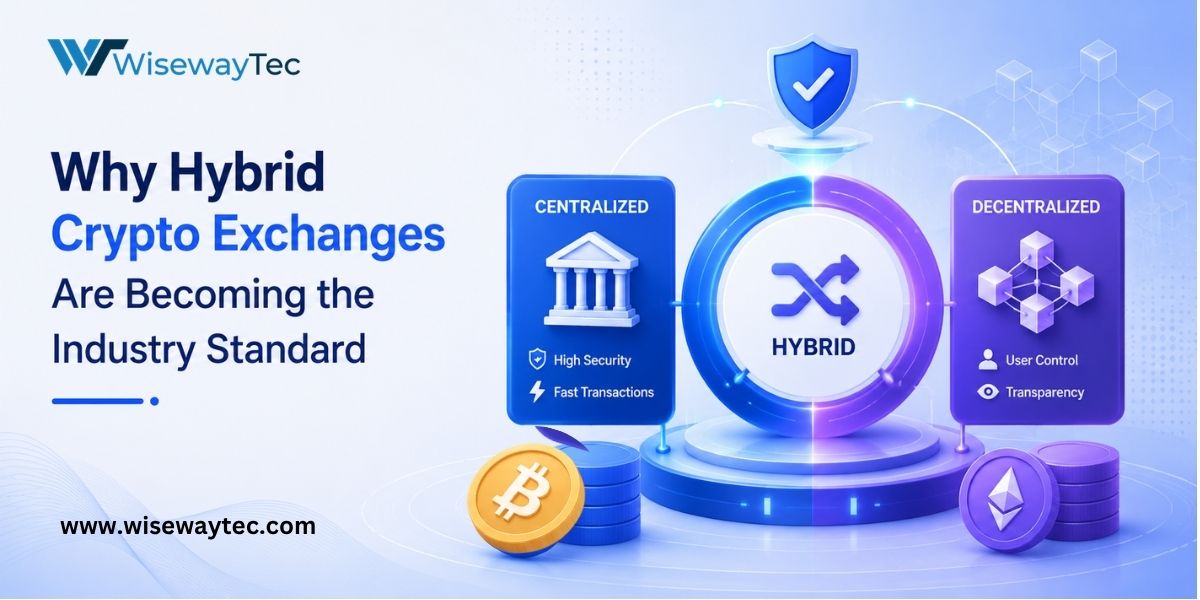
| Hybrid Exchange | Off-chain matching for speed, on-chain settlement for transparency | Businesses wanting CEX performance with DEX-level trust | More complex architecture—you inherit costs from both models |
| P2P Exchange | Buyers and sellers trade directly, often via escrow | Regions with limited banking rails or high remittance demand | Depends heavily on trust/reputation systems and dispute resolution |
A practical rule we give clients: if your primary goal is trading volume and fiat liquidity in year one, start CEX or hybrid. If your community values self-custody and you’re targeting DeFi-native users, DEX is the better long-term bet—but budget more time for smart contract audits.
Step-by-Step Cryptocurrency Exchange Development Process
1. Market Research and Positioning
Before any code is written, define who you’re building for. A retail day-trading audience needs different tools (fast onboarding, mobile-first UX, simple order types) than an institutional audience (API trading, deep order books, OTC desks). Skipping this step is the single most common founder mistake—many teams build a generic “clone of everything” exchange and then struggle to explain why anyone should switch from Binance or Coinbase.
Ask: What asset classes will you list? Which region is your primary user base? What’s your realistic liquidity story on day one? Will you bootstrap it, or is a market maker underwriting your order book?
2. Choosing a Business Model
Your revenue model determines your fee structure and feature priorities. Common models include:
- Trading fees (maker/taker spreads) — the most common baseline
- Withdrawal and deposit fees
- Listing fees for new tokens
- Margin and lending interest
- API and institutional access fees
- Native token utility (fee discounts, staking rewards)
Most successful exchanges combine two or three of these rather than relying on trading fees alone, since fee competition among established exchanges is intense.
3. Choosing Your Exchange Type
Use the comparison table above, but stress-test the decision against your compliance appetite. A CEX in a heavily regulated market (EU, US, or UK) means licensing obligations from day one. A DEX sidesteps custody-related licensing in many jurisdictions but doesn’t escape scrutiny entirely—regulators are increasingly looking at front-end operators and token listings even on “decentralized” platforms.
4. Licensing and Compliance Planning
This is where timelines quietly blow up. Regulatory requirements now vary sharply by region:
- European Union — MiCA is now the single licensing framework across all 27 member states. A Crypto-Asset Service Provider (CASP) authorization obtained in one country passports across the entire EU and EEA. The transitional period for platforms operating under old national registrations ends July 1, 2026 — after that, unlicensed operation is a hard stop, not a gray area.
- United States — Oversight remains split across the SEC, CFTC, and FinCEN, with state-level requirements like New York’s BitLicense adding another layer. Expect a patchwork rather than one federal standard in the near term.
- UAE, Singapore, Hong Kong — Each has built purpose-made virtual asset frameworks that are increasingly selective, favoring well-capitalized, well-documented applicants over speed of approval.
Practical takeaway: engage compliance counsel and a KYC/AML provider during architecture planning, not after your MVP is built. Retrofitting onboarding flows to match a regulator’s required verification steps is far more expensive than designing for it upfront.
5. Technology Stack Selection
Your stack decision affects both performance and hiring costs down the line. A common, battle-tested 2026 stack looks like:
- Frontend: React.js / Next.js for web, React Native or Flutter for mobile
- Backend: Node.js, Go, or Rust for high-throughput matching services; Python for analytics and ML pipelines
- Database: PostgreSQL for transactional integrity, Redis for caching and real-time order book state, sometimes a time-series database for market data
- Blockchain layer: Ethereum, BNB Chain, Solana, and increasingly L2s (Arbitrum, Base, Optimism) for lower gas costs on DEX components
- Messaging/Infra: Kafka or similar for event streaming between the matching engine, wallets, and risk systems
Go and Rust are increasingly favored for the matching engine specifically because garbage-collection pauses in some languages introduce latency spikes that are unacceptable under high order volume.
6. UI/UX Planning
Trading UX has two very different audiences that founders often conflate: retail traders who need simplicity and confidence-building cues (clear fee breakdowns, 2FA prompts, and anti-phishing indicators) and professional/institutional traders who need dense data, keyboard shortcuts, and advanced order types. Trying to serve both with one undifferentiated interface is a recurring design mistake—plan for a “simple mode” and “pro mode” from the wireframe stage, not as a post-launch add-on.
Also design your KYC onboarding flow with your licensing jurisdiction in mind from day one. A one-click signup that later needs to be retrofitted with multi-step verification is a costly redesign — not just a UI tweak.
7. Matching Engine Development
The matching engine is the heart of any exchange — the system that pairs buy and sell orders. Most production engines use price-time priority: orders at the best price execute first, and among equal prices, the earliest order wins. Beyond the core algorithm, a serious matching engine needs to support:
- New / Replace / Cancel order lifecycle management
- Mass quote and mass cancel functions (critical for market makers)
- Multiple order types — Limit, Market, Stop, Iceberg
- Time-in-force options (GTC, IOC, FOK)
- Sub-millisecond to low-millisecond latency under load
This is the one component where cutting corners creates existential risk. A basic matching engine can handle a slow-moving MVP; A production engine processing tens of thousands of orders per second requires serious engineering investment and load testing before launch.
8. Liquidity Integration and Market Making
An exchange with no liquidity is a ghost town, no matter how good the UI is. Founders frequently underestimate this — a common concern we hear is “we’ll add liquidity after we get users,” which is backwards. Users won’t stay on a platform with wide spreads and thin order books.
Real liquidity strategies include:
- Liquidity provider (LP) partnerships — connecting to established market makers or liquidity aggregators via API
- Cross-exchange connectivity — mirroring liquidity from larger exchanges to narrow your spreads
- Internal market-making bots — automated systems that provide two-sided quotes using your own capital or a partner’s
- AMM pools (for DEX models) — where liquidity providers deposit assets into pools in exchange for fee-sharing
Budget for liquidity from day one, either as capital for market-making or as a revenue-share agreement with a liquidity partner—not as an afterthought.
9. Wallet Development: Hot, Cold, and MPC
Wallet architecture is where most catastrophic exchange failures have happened historically — the Mt. Gox collapse alone wiped out roughly $450 million in user funds due to weak custody practices. A modern wallet architecture uses a tiered approach:
| Wallet Type | Purpose | Typical Allocation |
| Hot wallet | Facilitates instant withdrawals and day-to-day liquidity | 2–10% of total assets |
| Cold wallet | Offline storage for the bulk of user funds, air-gapped from the internet | 85–95% of total assets |
| MPC (Multi-Party Computation) wallet | Splits private key control across multiple parties/devices—no single point of failure, no single key ever fully assembled | Increasingly used for both hot operations and institutional custody |
MPC wallets have become the default recommendation for 2026 builds because they eliminate the classic “single private key on a single server” risk without the operational friction of full multi-signature cold storage for every transaction. Many exchanges now run a hybrid: MPC for hot wallet operations and deep cold storage (often with multi-signature and geographically distributed key shards) for reserves.
10. Admin Dashboard and Trading Engine Integration
Your admin panel is where your operations team lives day to day — user management, KYC review queues, withdrawal approval workflows, fee configuration, and real-time risk monitoring. Underinvesting here is a common mistake: founders pour budget into the trader-facing UI and treat the admin dashboard as an afterthought, then discover their compliance team has no efficient way to review flagged transactions once volume grows.
A well-built admin dashboard should give you real-time visibility into trading volume, wallet balances, suspicious activity flags, and system health — ideally with role-based access control so your compliance, finance, and engineering teams see only what they need.
11. KYC/AML Integration
Identity verification and transaction monitoring aren’t optional anywhere serious regulators operate. A modern KYC/AML stack typically includes:
- Document verification and liveness checks (often via third-party providers)
- Sanctions and PEP (Politically Exposed Person) screening
- Ongoing transaction monitoring for suspicious patterns
- Travel Rule compliance for transfers above regulatory thresholds
- Tiered verification — letting users do more (higher limits, more asset types) as they verify more
Design this as a progressive flow: minimal friction at signup, additional verification triggered by specific actions (larger withdrawals, fiat on-ramps), rather than forcing full KYC before a user can even explore the platform.
12. Security Architecture
Security isn’t a single feature — it’s a discipline applied at every layer:
- Application security: Multi-layer encryption (AES-256 at rest, TLS in transit), secure API authentication (OAuth2/JWT with short-lived tokens), rate limiting
- Account security: Mandatory 2FA, hardware key support (FIDO2/WebAuthn), anti-phishing codes, device fingerprinting
- Infrastructure security: DDoS mitigation, Web Application Firewalls, network segmentation between hot wallet servers and public-facing services
- Operational security: Withdrawal whitelisting, time-delayed large withdrawals, real-time anomaly detection powered by AI/ML models
- Independent audits: Smart contract audits (for DEX components) from firms like CertiK or Hacken, and periodic penetration testing for the full stack
13. API Integrations
APIs power everything from your mobile app to institutional trading desks to third-party portfolio trackers. Build for:
- REST and WebSocket APIs for order placement, market data, and account management
- FIX protocol support if you’re targeting institutional or high-frequency traders
- Rate-limited public APIs for market data (useful for listing on aggregators)
- Webhook support for deposit/withdrawal notifications
14. Payment Gateway and Fiat On/Off-Ramp
If you’re supporting fiat, you’ll need banking relationships or a payment processor partner — and this is often the most underestimated timeline risk in the entire build. Most banks classify crypto businesses as high-risk, and securing merchant accounts commonly takes three to six months. Teams regularly finish a technically polished exchange only to discover no bank is willing to onboard them at launch. Start these conversations in parallel with development, not after.
15. Blockchain Integration
Depending on your model, this means integrating node infrastructure for the chains you support (Bitcoin, Ethereum, Solana, and others), building deposit/withdrawal detection systems, and — for DEX or hybrid models — writing and auditing the smart contracts that handle swaps, liquidity pools, or settlement.
16. Testing
Testing an exchange goes well beyond functional QA:
- Load testing — simulating peak trading volume (think a sudden market crash or a viral token listing) to confirm the matching engine and infrastructure don’t buckle
- Security testing — penetration testing, smart contract audits, and fuzz testing on APIs
- Compliance testing — verifying KYC/AML flows actually block the scenarios they’re designed to catch
- Failover testing — confirming your disaster recovery plan actually works, not just exists on paper
17. Deployment
A phased rollout — closed beta, then limited public launch with trading limits, then full public launch — lets you catch issues under real (but controlled) load before your reputation is on the line with unlimited volume.
18. Post-Launch Maintenance and Monitoring
Launch is the beginning, not the finish line. Ongoing needs include 24/7 system monitoring, regular security patching, license renewals as regulations evolve, liquidity management, and continuous feature iteration based on trading data. Exchanges that treat post-launch support as optional are the ones that quietly lose users to downtime and slow support response times.
Common Mistakes Founders Make
- Underestimating licensing timelines — treating compliance as a formality instead of a multi-month workstream that should start during architecture planning
- Launching with no liquidity plan — assuming users will show up before there’s anything worth trading
- Skipping smart contract audits to save money — the single most expensive mistake in DEX development when it goes wrong
- Building the admin dashboard last — leaving operations and compliance teams without the tools they need at the exact moment volume picks up
- One-size-fits-all UX — ignoring the split between retail and professional trader needs
- No banking relationship secured before launch — discovering fiat rails aren’t ready months after the platform is
- Treating security as a checklist instead of a discipline — bolting on 2FA and calling it done, without withdrawal monitoring, anomaly detection, or a real incident response plan
Security Best Practices Checklist
- Cold storage for 85%+ of user funds
- MPC or multi-signature control over hot wallets
- Independent smart contract audit (for DEX/hybrid models)
- Mandatory 2FA and withdrawal whitelisting
- Real-time anomaly detection on withdrawals and login patterns
- DDoS protection and WAF at the network edge
- Documented, tested disaster recovery and incident response plan
- Regular third-party penetration testing (at least annually)
- Bug bounty program for ongoing vulnerability discovery
Cost Breakdown: Cryptocurrency Exchange Development in 2026
Cost estimates for crypto exchange development vary widely across the industry—largely because “build a crypto exchange” can mean anything from a $25,000 white-label deployment to a $2M+ custom institutional platform. Here’s a realistic breakdown by approach:
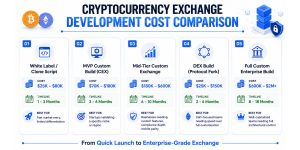
Component-level costs worth budgeting individually:
- Matching engine: $20,000 (basic) to $500,000 (production-grade, high-throughput)
- Wallet infrastructure (hot/cold/MPC): $30,000 – $150,000+
- Admin dashboard: $5,000 – $60,000
- Payment gateway integration: $5,000 – $80,000
- API development: $8,000 – $70,000
- Smart contract audits (per audit): $20,000 – $100,000, often needing multiple rounds
Ongoing costs — licensing renewals, cloud infrastructure, KYC provider fees per verified user, 24/7 support, and marketing — typically add 15–30% of your initial build cost annually. Founders who budget only for the build and not for year-one operations are consistently the ones who run out of runway before reaching profitability.
Build vs. White Label vs. Custom Development
| Factor | White-Label | Custom Development |
| Speed to market | Fastest — weeks | Slowest — months |
| Differentiation | Limited — shared codebase with other clients | Full control over features and branding |
| Cost | Lower upfront | Higher upfront, but no licensing dependency long-term |
| Ownership | You license the platform, not own the underlying code | You own every architectural decision |
| Best for | Validating demand quickly, limited budget | Long-term differentiation, institutional ambitions |
A pattern we see often: startups launch white-label to validate demand and generate revenue, then migrate to a custom build once trading volume justifies the investment. This “walk before you run” approach reduces risk without sacrificing long-term ambition—as long as you plan the migration path from day one rather than treating white-label as a permanent decision.
Future Trends: AI in Crypto Exchanges
AI has moved from marketing language to functional infrastructure in exchange development. The features that matter most heading into the rest of 2026:
- AI-powered fraud detection — pattern recognition models flagging suspicious withdrawal or trading behaviour in real time, faster than rule-based systems
- Smart order routing — algorithms that split large orders across liquidity sources to minimize slippage
- Predictive analytics dashboards — giving traders (and your risk team) forward-looking signals instead of just historical charts
- AI-driven KYC automation — document verification and liveness detection that cuts onboarding time from days to minutes
- Conversational AI support agents — handling tier-1 support queries so human teams focus on complex compliance or dispute cases
- Dynamic fee optimisation — adjusting maker/taker fees in real time based on liquidity conditions and competitive positioning
The exchanges gaining ground in 2026 aren’t necessarily the ones with the most trading pairs—they’re the ones using AI to make trading feel safer, faster, and more personalised, while keeping compliance teams ahead of regulatory expectations rather than reacting to them.
Conclusion
Building a cryptocurrency exchange in 2026 is a fundamentally different exercise than it was even three years ago. Regulation has matured into a real gatekeeper, AI has become functional infrastructure rather than a feature checkbox, and users have far less patience for platforms that get security or liquidity wrong. The founders who succeed aren’t necessarily the ones who move fastest—they’re the ones who plan compliance, liquidity, and security as core architecture decisions from day one, not as afterthoughts bolted on before launch.
Whether you’re weighing a white-label MVP to validate demand or a fully custom, institutional-grade build, the fundamentals stay the same: a resilient matching engine, a tiered wallet security model, a compliance framework built for your target markets, and a liquidity strategy that doesn’t depend on hope.
At WisewayTec, we’ve spent 8+ years building blockchain and Web3 infrastructure — including centralized, decentralized, and hybrid exchange platforms engineered for security, scalability, and regulatory readiness. If you’re evaluating what a 2026-ready exchange build actually looks like for your business—architecture, compliance pathway, timeline, and realistic cost—our team is glad to walk through the specifics with you. You can also explore how we approach crypto wallet development, smart contract development, and broader blockchain development to see how these pieces fit together into a complete exchange ecosystem.
Frequently Asked Questions
What is cryptocurrency exchange development?
It’s the complete process of designing, building, and deploying a platform for buying, selling, and trading digital assets—covering everything from the matching engine and wallet infrastructure to KYC/AML compliance and post-launch security monitoring.
How much does it cost to build a crypto exchange in 2026?
Costs typically range from $25,000 for a basic white-label deployment to $2,000,000+ for a full custom, institutional-grade build. Most mid-market startups land between $70,000 and $600,000, depending on features, compliance scope, and whether they choose CEX, DEX, or hybrid architecture.
How long does it take to build a cryptocurrency exchange?
A white-label exchange can launch in 6–12 weeks. A custom-built platform typically takes 6–12 months, depending on feature complexity, the number of supported blockchains, and how demanding the target jurisdiction’s licensing process is.
Is a white-label exchange a good long-term option?
It’s a strong option for validating demand quickly and generating early revenue. Most businesses that scale successfully eventually migrate to custom infrastructure once trading volume and feature needs outgrow the shared platform’s limitations.
What’s the difference between hot wallets, cold wallets, and MPC wallets?
Hot wallets stay online for instant withdrawals but carry higher risk exposure. Cold wallets are stored offline and hold the bulk of user funds securely. MPC (Multi-Party Computation) wallets split private key control across multiple parties, removing any single point of failure — increasingly the preferred approach for both hot wallet operations and institutional custody in 2026.