Building a blockchain-based application in 2026 involves more than adding smart contracts to a traditional app. It requires choosing the right blockchain network, defining what runs on-chain and off-chain, designing a simple user experience, developing secure smart contracts, integrating wallets and APIs, and testing before launch.
No matter what kind of Web3 product you are aiming to create, such as a decentralised finance platform, an NFT marketplace, a blockchain wallet, a gaming application, a supply-chain solution, or another kind of Web3 product, the development method can have a significant impact on security, scalability, cost, and long-term performance.
In this guide, you’ll learn how to build a blockchain-based application in 2026, including the complete blockchain application development process, technology stack, essential features, security considerations, development costs, common challenges, and how to choose the right blockchain development company for your project.
What Is a Blockchain-Based Application?
A blockchain-based application is software that uses a blockchain network to store data, execute transactions, or run business logic. Many blockchain applications use smart contracts to handle specific functions without depending entirely on a centralised authority.
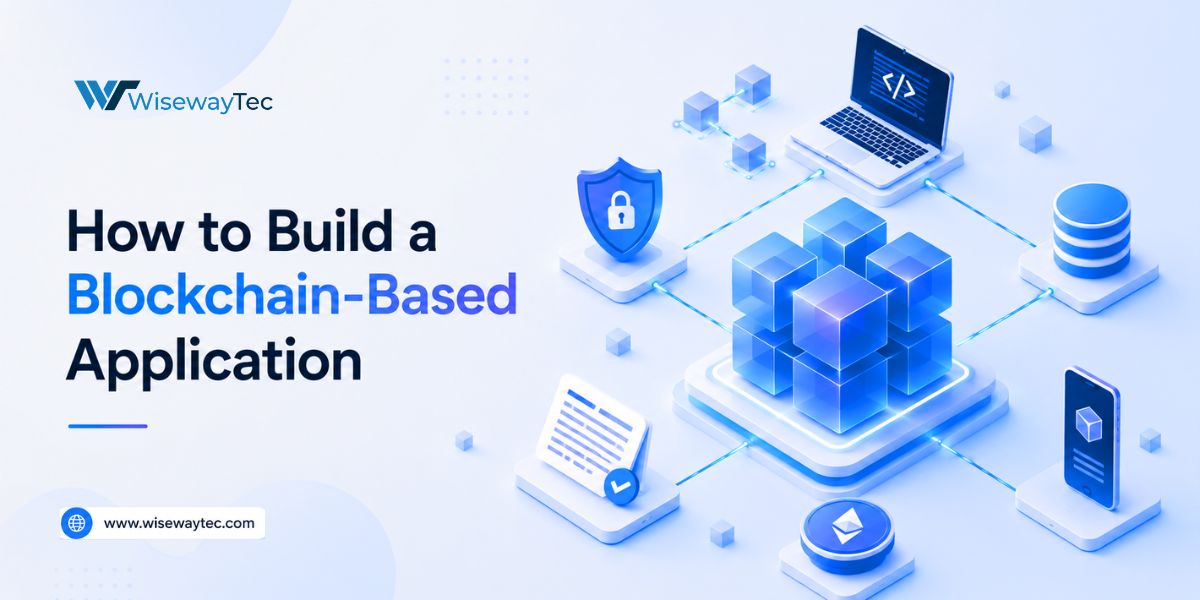
A typical blockchain application could have the following components:
- Frontend
- Smart contracts
- Backend
- Wallets
- Blockchain nodes or remote procedure call (RPC) services
- Indexing or query service
- Databases
- Monitoring and security tools
Unlike a traditional application, a blockchain application often needs to have some components that run on-chain and some that run off-chain. Storing everything on-chain can be impractical or unnecessary.
Why Build a Blockchain Application in 2026?
Blockchain development has become more flexible as networks, development frameworks, wallets, and infrastructure have matured.
Businesses can use blockchain applications when they need features such as:
Transparency
Blockchain records can provide a shared and verifiable history of transactions or activities.
Decentralized Ownership
Users can interact with assets or applications without relying completely on a single centralised platform.
Automatic Transactions
Smart contracts can be programmed to carry out the relevant predefined actions automatically when its precondition is met.
Digital Assets Management
With blockchain technology, companies can issue, move, manage and even prove the ownership of digital assets.
Improved Traceability
Using the features of blockchain technology, businesses can monitor their assets throughout their life and through multiple stakeholders.
Reduced Dependence on Intermediaries
In suitable use cases, blockchain can reduce the need for certain third-party verification or settlement processes.
However, blockchain is not always the best solution for all problems. If a traditional database can solve the issue at hand better than blockchain technology, it would be better to use the former to avoid extra expenses. The current practice of development now prioritises whether there is a need for it before choosing what chain to use or proceeding to code smart contracts.
How to Build a Blockchain-Based Application
The blockchain application development process generally moves from business validation to architecture, development, testing, deployment, and ongoing maintenance.
1. Identifying the Business Use Case
The first thing to do is definitely lay out the end goals of your application.
Seek to answer questions such as:
- What problem is this application aimed at resolving?
- Who will use it?
- Why is blockchain needed?
- What information should be stored on-chain?
- Which operations require smart contracts?
- What information should remain off-chain?
- Does the application require tokens or digital assets?
- Which compliance requirements are applicable?
For instance, a supply chain app could be using blockchain technology to facilitate a joint ledger of items being shipped between manufacturers, distributors, and retailers.
For instance, a digital market could be using smart contracts that allow asset ownership and transactions.
The use case is instrumental in making sure that the right choice is made and the frequent mistake of selecting the blockchain first and then trying to find a business issue for it is avoided.
2. Choose the Right Blockchain Platform
The blockchain network you pick will have a huge impact on transaction costs, programmability, scalability, development tools, UX, and future maintenance.
Consider these options:
- Ethereum and EVM-compatible networks
- Layer 2 solutions
- Solana
- Avalanche
- BNB Chain
- Polygon
- Hyperledger Fabric
Or any other network (public or permissioned) of your choice
There is no one-size-fits-all solution for blockchain networks.
What should be considered when making decisions:
- Transaction speed
- Network fees
- Scalability
- Smart contract support
- Developer ecosystem
- Compatibility with wallets
- Security
- Community and infrastructure
- Regulatory framework
- Future maintenance
For instance, if a consumer application is to be developed for use by everyone, it may need a public blockchain. Otherwise, if an application is developed for a specific purpose by a closed group of people, a permissioned blockchain can be used for that.
3. Develop the Blockchain Application Architecture
Architecture plays a key role in linking different parts of your application.
A blockchain application usually consists of multiple components:
Client-side → Server-side/API → Blockchain → Smart Contracts → Blockchain Technology
Additionally, wallet features, database, indexing, authentication procedures, and additional APIs may be integrated.
One of the important factors of architecture is to understand what is managed on-chain and what is managed off-chain.
On-chain data
Perfect data for processing when blockchain confirmation plays a role in validation:
- Information on property
- Transaction information
- Token information
- Contract rules
- Events requiring validation
Off-chain data
Used mainly in cases when:
- Large files should be processed.
- Sensitive information should be used.
- It is search-heavy data.
- Temporary information is processed.
- Data is huge, thus blockchain validation is not that crucial.
4. Design and Develop Smart Contracts
Smart contracts play an important role in various blockchain applications. They define rules concerning blockchain projects. Based on the application itself, smart contracts can regulate:
- Financial payments
- Token transactions
- Property ownership
- Staking
- Market transactions
- Access rights
- Management
- Business rules automation
In EVM blockchain applications, Solidity is commonly used as a smart contract programming language. Different blockchain ecosystems may adopt their own programming languages and development approaches.
Being developed smart contracts must be properly implemented, because a mistake could lead to negative consequences once they are in a public network environment.
There are many available frameworks and tools, including Hardhat, Foundry, OpenZeppelin libraries, testing environments, etc.
5. Build the Frontend Application
The frontend is the part of the application that the user sees and works with.
The blockchain application must ensure that users do not need to understand complex blockchain terminology to perform specific tasks correctly.
The interface must show the following:
- Ways to connect wallets
- User accounts
- Networks
- Transaction status
- Gas fees
- Confirmations
- Successful transactions
- Failed transactions
Common frontend technologies are React or Next.js, as well as Web3 libraries that connect the frontend with blockchains.
Choosing the technology stack is driven not by the need to follow certain rules but by the needs of the application.
6. Integrate Cryptocurrency Wallets
The incorporation of wallets will give users access to their blockchain account and make transactions possible. What decides the choice of wallets? The answer may lie in the type of blockchain being used and the targeted users, for example:
- MetaMask
- Wallets based on WalletConnect technology
- Coinbase Wallet
- Some specialised wallets
A user will have a great experience if they are informed about their actions.
The application will also be able to assist the user if:
- They deny the transaction request.
- The transaction is pending.
- The transaction fails
- The user switches to another blockchain.
- The wallet disconnects
- The transaction goes through
Each of these points may seem insignificant, but they are important for the successful operation of any blockchain app.
7. Develop the Backend and Data Layer
It is not required for each component of a blockchain application to operate on the blockchain. Certain functions can be performed by the backend and include the following:
- User preferences
- Notifications
- API integration
- Authentication
- Business analytics
- Application settings
- Off-chain database
- Administrative tasks
To make it possible to perform efficient search and display of blockchain events, an indexing layer can prove useful for certain types of applications.
Modern decentralised apps often combine smart contracts, front-end, and indexing/data layers instead of fetching all app data from the blockchain.
8. Test the Blockchain Application
Testing should happen throughout development rather than only before launch.
A blockchain application can require several levels of testing.
Verification of Smart Contracts
Carry out the tests:
- Functions available within the contract
- Controls for access
- Logic behind transactions
- Cases that act as outliers
- Management of errors
- Limits for permission
Testing of Frontend
Carry out checks:
- Connections from wallets
- Ways in which a user can interact
- Switching of networks
- Status of the transactions
- Design that adapts to various screens
Verification of integration
Check if communication takes place with:
- Frontend
- Backend
- Smart Contracts
- Wallets
- Infrastructure for Blockchain
- APIs from outside
Testing in Testnet
Before launching a project on mainnet, carry out testing of the whole application in an appropriate testing environment.
This will let developers pinpoint problems without putting users’ real funds at risk.
9. Do a Security Audit
Security is significant for development and needs to be taken seriously.
Smart contracts can be vulnerable and lead to serious losses.
A security audit will show you:
- The risks of the process of reentrancy
- The problems with access control
- Errors with integers and arithmetic
- Incorrect validation of inputs
- Mistakes in business logic
- Usage of upgradeable smart contracts
- Issues with tokens
- The effect of oracles
- The interaction with external contracts.
An independent audit will be important if the value transferred through a smart contract is considerable before it is launched to the mainnet.
10. Deploy the Application
Upon completion of development, testing, and security assessments, deployment of the application can occur.
The process of deploying the smart contract involves the release of the compiled code on one of the blockchain networks.
In Ethereum, the deployment will require a transaction, which implies the payment of network fees.
A usual launch may include the following steps:
- Final review of the code
- Setting up the production environment
- Deploying the smart contracts
- Verifying the contracts
- Deploying the backend
- Deploying the frontend
- Configuring the wallets
- Setting up the monitoring
- Configuring the analytics
Finally, user testing of the application.
11. Monitor and Maintain the Application
Launching the application is not the end of blockchain development.
After launching the product, the developers will need to observe the following:
- Failures occurring in the transactions
- Activities in smart contracts
- Performance of applications
- Availability of RPC and API
- Errors concerning the wallet
- Activities of the users
- Events concerning security
Changes taking place in the network.
Regular maintenance can include improvement of the user interface, updates of backend solutions, optimisation of infrastructure, responding to the changes in the blockchain space, etc.
Technology Stack for Blockchain App Development
The right technology stack depends on the application and blockchain network.
A typical stack may include:
| Development Area | Common Technologies |
| Frontend | React, Next.js |
| Smart Contracts | Solidity, Rust |
| Web3 Integration | viem, ethers.js, wagmi |
| Backend | Node.js, Go, Python |
| Database | PostgreSQL, MongoDB |
| Blockchain Access | RPC providers or blockchain nodes |
| Wallets | MetaMask, WalletConnect-compatible wallets |
| Testing | Unit, integration, fork and testnet testing |
| Infrastructure | Cloud hosting, monitoring and logging tools |
The stack should be selected based on the application’s requirements, expected traffic, blockchain ecosystem, security needs, and the development team’s expertise.
How Much Does It Cost to Build a Blockchain Application?
The cost of blockchain application development depends heavily on the project’s scope.
Crucial cost factors are:
- Complexity of the application
- Number of platforms
- Complexity of the smart contracts
- UI/UX requirements
- Selection of blockchain
- Integration of wallets
- Development of back-end
- Integration of external services
- Security testing and auditing
- Infrastructure
- Regulations
- Maintenance after launch
Creating a simple blockchain MVP requires significantly less developer effort compared to building a DeFi platform, marketplace, or enterprise blockchain solution.
Thus, instead of charging the same fixed cost for any project, companies should calculate the estimate of the project after determining the characteristics, architecture, blockchain network, security requirements, and scale of the project.
How to Choose a Blockchain Development Company
Choosing the right development partner can significantly influence the success of your application.
When you assess a blockchain development firm, consider these matters:
Technical Level of Expertise
You must verify if the team has adequate technical experience for the specific ecosystem and development requirements.
Past Work
Review the case studies and examples of the company’s past work relevant to your requests instead of general statements about the blockchain development field.
Smart Contract Competence
Ask the firm about their approach to smart contract design, testing, auditing, and security reviews.
Development Methodology
A competent company should have an established process for prototyping, design, implementation, and post-launch support.
Post-Launch Support
Find out about the company’s maintenance, security upgrades, infrastructure support, and enhancements after the initial launch.
Why Choose WisewayTec for Blockchain Application Development?
Building a blockchain application requires more than writing smart contracts. It requires a combination of product planning, blockchain expertise, user-focused design, secure development, testing, and ongoing technical support.
WisewayTec can assist you with transforming your idea into an actionable development plan if you’re engaged in a development project with a blockchain-based product.
No matter if you are designing a blockchain marketplace, DeFi app, token-based solution, Web3 product, or corporate software product, contacting an experienced blockchain development firm allows you to proceed from a concept to a product.
Start Your Blockchain Application Development Journey
Developing a blockchain-based app involves more than just selecting a blockchain platform and writing the smart contracts. To create a successful solution, you should pay special attention to your architecture, secure development, interface design, and the development methodology.
If you have a blockchain application idea, you should first define your business goals, distinguish the features you need from the ones you want, and choose the tech stack that can support your long-term plans. It is also worth mentioning that you can address all technical difficulties related to the blockchain application development process with the help of a good blockchain software development company, which can also help you with your smart contracts, integrate cryptocurrency wallets, and test your project.
By following the best approach in the development of the project, you can create a secure, functional, and scalable application.
Frequently Asked Questions
1. What is the procedure for making an application based on the blockchain?
Everything starts with identifying the use case, choosing a blockchain to work with, designing the architecture of the platform, creating smart contracts and an application, and then making tests before the release.
2. What steps does blockchain application development include?
The development process usually includes stages such as planning, choosing the blockchain to be used, UI/UX design, smart contract development, integration, testing, providing security, and launching the application.
3. Which blockchain is going to be the most suitable for the creation of an application in 2026?
The best blockchain depends on aspects such as scalability, fees, security, performance, and the technical requirements of the application.