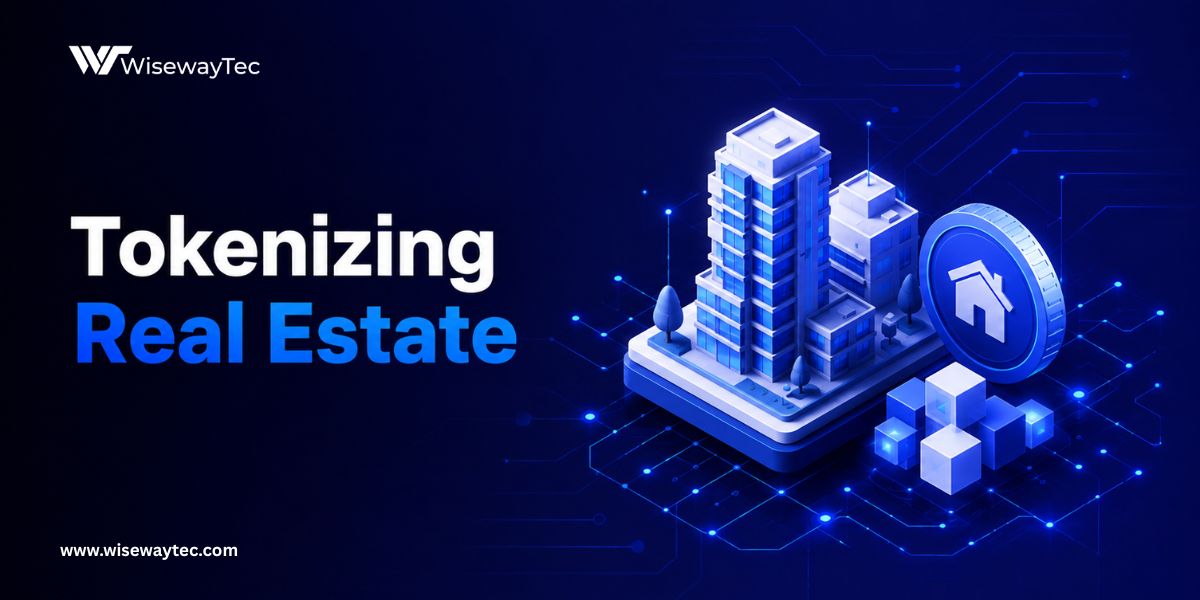
For most of modern history, real estate has been the largest asset class on Earth — and the most stubbornly illiquid. A skyscraper in Mumbai or a logistics park in Frankfurt could take months to sell, demand million-dollar minimums, and require an army of lawyers, escrow agents and notaries to change hands. Tokenization breaks that lock.
By representing fractional ownership of a property as digital tokens on a blockchain, a sponsor can split a $40 million building into 40,000 tokens of $1,000 each — tradable globally, settling in seconds, with rental income auto-distributed via smart contract. But here’s the catch the marketing brochures rarely mention: the token is the wrapper. The enforceable promise is still written in legal documents. Get the legal and technical stack wrong, and you don’t have a security — you have a lawsuit.
This guide, prepared by the team at WisewayTec, walks through both layers — the legal framework regulators now expect, and the technical architecture that actually delivers compliance on-chain. Whether you’re a developer, fund sponsor, or builder evaluating real estate tokenization in 2026, this is the map.
The Market in Numbers (2026)
Tokenized real estate has officially exited pilot status. By early 2026, the segment represents the largest asset class within real-world-asset (RWA) tokenization — ahead of bonds, equities and private credit.
What “Tokenizing Real Estate” Actually Means
A common misconception: when you mint a token, the deed automatically moves. It doesn’t. In every major jurisdiction in 2026, land registries still hold the legal title — what you tokenize is a claim against an entity that holds the property.
In practice, three things must align:
- A legal vehicle (usually a Special Purpose Vehicle — an LLC, LP, or trust) that holds title to the physical property.
- A security instrument (equity shares in the SPV, a note backed by rental cashflows, or a beneficial interest) — this is what the token represents.
- A blockchain token that digitally encodes ownership of that security and enforces transfer rules via smart contract.
The Legal Framework: Jurisdiction by Jurisdiction
By early 2026, real estate tokenization has moved from regulatory grey-area to formal frameworks in every major financial hub. Here’s the landscape:
United States — SEC, GENIUS Act, UCC Article 12
The SEC’s January 28, 2026 joint guidance on tokenized securities confirmed the principle the industry had long expected: placing an asset on a distributed ledger does not change its fundamental nature. A tokenized real-estate offering is still a securities offering, and must either register or fit an exemption — most commonly:
- Regulation D 506(c) — sales to accredited investors only, with general solicitation permitted.
- Regulation S — offshore offerings to non-US persons.
- Regulation A+ — limited public offerings up to $75 million per year.
The bigger story in 2026 is UCC Article 12. As of this year, over 30 U.S. states have enacted the 2022 amendments to the Uniform Commercial Code, creating a legal category called Controllable Electronic Records (CERs). This allows a bank to perfect a security interest in a tokenized asset by “control” — essentially treating a digital token as legally equivalent collateral to a stock certificate. For the first time, tokenized real estate can be pledged to a traditional bank loan, bridging DeFi and CeFi.
The GENIUS Act (passed 2025) and the pending Clarity Act (expected to pass in 2026) further codify which digital assets are securities versus commodities, and lay out federal registration rules for brokers and dealers handling tokenized securities.
European Union — MiCA & MiFID II
The Markets in Crypto-Assets Regulation (MiCA) is fully operational across the EU as of 2026. MiCA itself governs digital-asset custody and stablecoins, but tokenized real estate typically falls under the older MiFID II framework as a “transferable security.” Issuers must publish standardized white papers, maintain capital reserves, and comply with prospectus rules unless an exemption applies.
India — SEBI’s SM REIT Framework
Following the SEBI (Real Estate Investment Trusts) (Amendment) Regulations 2024, fractional ownership platforms in India must now register as Small and Medium REITs (SM REITs). Schemes must have an asset value between ₹50 crore and ₹500 crore with a minimum of 200 investors. KYC is mandatory and most platforms use Aadhaar-based eKYC for Indian retail investors.
UAE — VARA (Dubai) & ADGM/DIFC (Abu Dhabi)
The Virtual Assets Regulatory Authority (VARA) in Dubai now operates a Phase II framework specifically covering tokenized property. ADGM and DIFC in Abu Dhabi apply common-law-based securities frameworks broadly analogous to U.S. rules.
Singapore — MAS
The Monetary Authority of Singapore (MAS) treats tokenized real-estate securities under existing capital-markets law, requiring rigorous KYC, AML, and data-protection standards under the PDPA.
| Jurisdiction | Primary Regulator | Key Framework | Typical Structure |
|---|---|---|---|
| USA | SEC, state banking regulators | Reg D / Reg S / Reg A+, UCC Art. 12 | Delaware LLC + token = equity |
| EU | ESMA + national regulators | MiCA + MiFID II | Luxembourg SCA or SARL + STO |
| India | SEBI | SM REIT Regulations 2024 | Trust structure + ₹50-500 Cr AUM |
| UAE | VARA (Dubai), FSRA (ADGM) | VARA Rulebook Phase II | Free-zone SPV + licensed issuer |
| Singapore | MAS | Securities & Futures Act + PSA | SG entity + accredited investor offer |
The Howey Test still rules
Across all five jurisdictions above, regulators apply the same substantive question
(a variant of the U.S. Supreme Court’s 1946
Howey Test): is there an investment of money, in a common enterprise,
with an expectation of profit derived from the efforts of others? If yes, you’re issuing
a security — full stop. Tokenization changes how you issue and trade it,
not whether securities law applies.
The Technical Stack: What Goes On-Chain
A production-grade real-estate tokenization platform in 2026 typically has six layers. Here’s how they stack:
Token Standards: ERC-3643 vs ERC-1400
Plain ERC-20 tokens are not fit for purpose for regulated real estate — anyone can hold them, transfers are permissionless, and there’s no compliance logic. Two purpose-built standards dominate in 2026:
| Feature | ERC-3643 (T-REX) | ERC-1400 |
|---|---|---|
| Status | Final EIP (Dec 2023) | Draft / not officially merged |
| Compliance check | On-chain validator + identity registry | Off-chain key validates each transfer |
| Identity | ONCHAINID (built-in) | External integration needed |
| Partitions | No partitions; modular rules | Yes — multiple tranches in one token |
| ERC-20 compatibility | Full | Partial |
| Assets tokenized to date | $28B+ (Tokeny figures) | Lower adoption |
For most new 2026 deployments — especially real estate — ERC-3643 is the default. It’s the only permissioned standard that has officially been accepted into the Ethereum master GitHub, and its on-chain identity model (via ONCHAINID) cleanly maps to KYC and accredited-investor rules without needing off-chain signatures for every trade.
How an ERC-3643 Transfer Actually Works
When Alice wants to send 100 tokens to Bob, the token contract makes three on-chain checks before the transfer executes:
- Identity check — Is Bob’s wallet registered in the Identity Registry? Does his ONCHAINID hold valid claims (KYC, accredited-investor status, jurisdiction)?
- Compliance check — Does the transfer violate any offering rules? (Max holders, lock-up period, country restrictions, max wallet size?)
- Eligibility check — Are the issuer’s whitelisted claim issuers still trusted? Have Bob’s claims expired?
If any check fails, the transaction reverts. If all pass, tokens move. This compliance-at-the-protocol-level is what makes ERC-3643 viable for securities — every wallet-to-wallet movement is auditable and rule-bound.
Why Tokenize? Real Benefits, Honestly Stated
The numbers above are composite estimates from industry case studies — they vary widely by jurisdiction, asset, and platform. The honest read is this:
- Settlement goes from T+30 days (traditional closing) to T+0 (atomic on-chain swap). This is real and verified.
- Minimum tickets drop from $50,000–$250,000 (typical private syndication) to $50–$500. This is genuinely democratizing.
- Liquidity is the most over-promised benefit. As of 2026, secondary markets for tokenized real estate are still thin — most trading still happens on the platform of issuance. Swift’s collaboration with Chainlink and BNY Mellon, BNP Paribas, Citi and Lloyds is changing this, but interoperability is a 2026–2027 story, not a 2024 story.
- Cost savings on closing and administration are real (typically 40–65%), but you spend that savings up-front on platform development, legal structuring, and ongoing compliance.
Who’s Actually Doing This in 2026?
This is no longer hypothetical. The headline 2024–2026 deployments include:
- T-RIZE Group — tokenized a $300 million residential development, one of the largest single-asset tokenizations to date.
- JPMorgan’s Kinexys network — processed $1.5 trillion in tokenized transactions by end of 2024 and is now piloting on-chain FX settlement.
- Goldman Sachs — preparing three tokenized products for rollout, with custody integration via BNY Mellon.
- RealT — early Detroit-property tokenization pioneer, still operational with hundreds of properties tokenized for global retail investors.
- Elevated Returns — tokenized the St. Regis Aspen Resort in one of the earliest large-scale STOs (the Aspen Coin).
Latest update: SEC Joint Guidance, January 28, 2026
The SEC issued joint guidance defining two formal taxonomies for tokenized securities:
Issuer-Sponsored Tokenization (the issuer itself integrates blockchain records with its own books)
and Third-Party Sponsored Tokenization (a registered transfer agent or platform mirrors off-chain records on-chain).
For real estate sponsors, this clarity removed years of ambiguity about whether SPV-issued tokens can be reflected on a public blockchain
without changing the security’s regulatory status. The answer is yes.
What Can Still Go Wrong
Tokenization is not a silver bullet. The risks worth understanding before issuing:
Legal risk
Treating tokenization as a way to “avoid securities law” is the fastest path to enforcement action. The SEC, ESMA, MAS and VARA have all publicly stated they look at economic substance over form. A token that looks like a duck and quacks like a duck is a security duck.
Liquidity mirage
“Fractional ownership = liquidity” is the most-repeated claim and the most often wrong. Tokens can be permissionless to transfer technically, but resale rules (Rule 144 lock-ups, ATS requirements, KYC re-checks) still apply. A 12-month lock-up is a 12-month lock-up, whether the security is paper or a token.
Smart contract risk
Bugs, exploits and admin-key compromises can drain or freeze assets. Every contract handling real-estate value must undergo third-party audits (Certik, Quantstamp, OpenZeppelin, QuillAudits) before mainnet deployment.
Oracle and off-chain risk
Tokens settle on-chain in seconds, but rent collection, property maintenance, and tax filings still happen off-chain. A bad property manager can destroy returns no matter how elegant the token contract is.
Tax ambiguity
As of mid-2026, the IRS has still not issued definitive guidance on wash-sale rules, de minimis rules, or staking treatment for tokenized real estate. Most issuers conservatively treat tokens like the underlying securities for tax purposes — but professional advice is essential.
How WisewayTec Helps
Building a compliant tokenization stack from scratch typically takes 6–9 months and costs $250K–$1M+ depending on jurisdiction and asset class. At WisewayTec, we’ve shortened that path significantly. Our real-estate tokenization services include:
- Smart contract development — ERC-3643 / ERC-1400 token contracts with audited compliance modules
- Legal-tech architecture — SPV structuring guidance in coordination with your securities counsel, across US, EU, UAE, India and Singapore
- KYC/AML integration — production-grade onboarding via Onfido, Sumsub, Jumio + ONCHAINID
- Investor portal & dashboard — branded front-end for primary issuance, secondary trades, and yield distribution
- Custody integration — qualified custodian connections + multisig admin controls
- Audit coordination — security audit liaison with leading blockchain security firms
Planning a real-estate tokenization project?
WisewayTec’s blockchain engineers, smart contract auditors and tokenization architects can take you from concept to mainnet — compliantly.