Something unexpected happened in the crypto exchange market this year. The old debate between centralized and decentralized platforms quietly became irrelevant. A third model rose from the intersection of both, and it is now setting the pace for everything that follows.
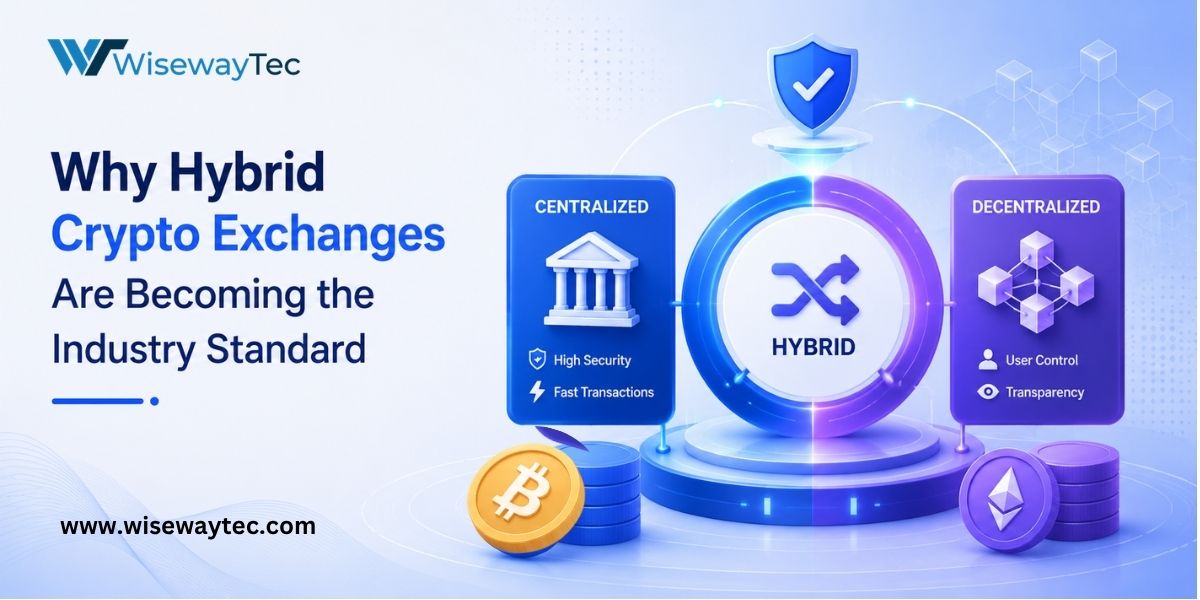
The hybrid crypto exchange is not a compromise between two systems. It is an entirely new design philosophy that takes the speed, liquidity, and user experience of centralized platforms and fuses them with the self-custody, transparency, and trust guarantees of decentralized protocols.
And the market has noticed. With over 260 active exchanges globally and the total crypto exchange market projected to surpass $100 billion in annual revenue by late 2026, platform builders are under immense pressure to deliver more than just a matching engine. They need infrastructure that satisfies institutional compliance requirements, gives retail users custody of their own assets, integrates DeFi earning opportunities, and still loads faster than a fintech app.
Hybrid exchanges deliver all of that. This guide breaks down exactly why they are dominating, how their architecture works under the hood, and the step-by-step roadmap to build one from scratch or with a white-label foundation.
“Whether you are an enterprise entering the digital asset space or a founder launching your first trading platform,
this is the most important architectural decision you will make in 2026.”
What Exactly Is a Hybrid Crypto Exchange?
A hybrid crypto exchange is a dual-layered trading platform that runs order matching and execution through a high-performance centralized engine while settling trades and storing user assets through decentralized, on-chain mechanisms.
Think of it this way: the speed comes from centralization, and the trust comes from decentralization. Users get the snappy experience they expect from platforms like Coinbase or Binance, but their funds never sit in a company-controlled hot wallet. Instead, settlement happens on-chain through smart contracts, and users retain custody of their private keys at all times.
The Dual-Layer Design
Centralized Layer: Handles user onboarding, KYC verification, order matching, liquidity aggregation, fiat on-ramps, and the trading interface. This layer is optimized for speed and can process thousands of orders per second with sub-millisecond latency.
Decentralized Layer: Manages asset custody through non-custodial smart contracts, executes on-chain settlement, provides transparent proof of reserves, and enables users to withdraw assets to personal wallets at any time without platform permission.
This separation of concerns is the core innovation. The centralized engine never touches user funds. The decentralized layer never slows down the trading experience. Each layer does what it does best, and the result is a platform that feels fast but operates trustlessly.
3. CEX vs DEX vs Hybrid: A Side-by-Side Comparison
Before diving deeper into architecture, it helps to see how hybrid exchanges stack up against traditional models across the features that matter most to both traders and platform operators.
| Feature | CEX | DEX | Hybrid Exchange |
| Trade Speed | Milliseconds | Seconds to minutes | Milliseconds |
| Asset Custody | Exchange holds funds | User holds funds | User holds funds |
| Liquidity Depth | Very High | Low to Medium | High |
| KYC/AML Compliance | Built-in | Minimal or none | Configurable per jurisdiction |
| User Onboarding | Easy (email/ID) | Complex (wallet required) | Easy + wallet option |
| Transparency | Opaque (trust-based) | Fully transparent | Transparent settlement |
| Fiat On-Ramp | Yes | Rarely | Yes |
| DeFi Integration | Limited | Native | Modular plug-in |
| Institutional Ready | Yes | Rarely | Yes |
| Single Point of Failure | Yes | No | Minimized |
The comparison makes one thing clear. Hybrid exchanges do not sacrifice one strength for another. They absorb the best attributes of both models while neutralizing their weaknesses. For platform builders, this means you can serve institutional clients who demand compliance and retail users who demand self-custody on the same platform, without maintaining two separate systems.
Why Hybrid Exchanges Are Winning in 2026
Several forces are converging to make hybrid exchanges the default choice for new platform launches. Let us unpack each one.
4.1 The FTX Aftermath Changed Everything
The collapse of FTX in late 2022 was not just a bankruptcy. It was a permanent psychological shift for the entire industry. Traders learned that centralized custody is a single point of failure. Regulators learned that opaque balance sheets are unacceptable. And builders learned that trust must be provable, not promised.
Hybrid exchanges answer this directly. By moving asset custody to smart contracts and enabling real-time proof of reserves through Merkle tree cryptography and zero-knowledge proofs, they make insolvency risk structurally impossible rather than relying on auditor assurances.
4.2 Institutional Capital Demands Both Speed and Compliance
Institutional traders need sub-millisecond execution, deep order books, and advanced API access. They also need KYC/AML compliance, regulatory reporting, and audit trails. Pure DEX platforms cannot deliver the first set of requirements. Pure CEX platforms cannot deliver trustless custody. Hybrid architecture serves both without compromise.
4.3 Regulatory Maturity Rewards Flexible Architecture
The global regulatory landscape has matured dramatically in 2026. The EU’s MiCA regulation, the US GENIUS Act, Singapore’s MAS framework, and Dubai’s VARA guidelines all require exchanges to demonstrate custody safeguards, transparent reserves, and compliance automation. Hybrid exchanges can embed these requirements directly into their smart contract layer, making compliance a technical feature rather than a manual process.
4.4 DeFi Integration Creates New Revenue Streams
Hybrid exchanges are not limited to spot and futures trading. Their modular architecture allows seamless integration of DeFi functionalities like staking, lending, yield farming, and liquidity provision. This means users never need to leave the platform to access decentralized earning opportunities, and exchange operators capture additional revenue from these services.
4.5 AI-Native Platforms Need Hybrid Infrastructure
Artificial intelligence is now embedded into the core of exchange operations. From fraud detection and anomaly monitoring to personalized trading signals and smart order routing, AI requires both centralized processing power and decentralized data integrity. Hybrid architecture provides the perfect substrate for AI-native exchange features.
Inside the Architecture: How a Hybrid Exchange Actually Works
Understanding the internal architecture is critical whether you are building from scratch or evaluating a white-label solution. Here is how each layer functions and connects.
5.1 The Centralized Matching Engine
The matching engine is the heartbeat of any exchange. In a hybrid model, it operates off-chain for maximum speed. High-performance engines built in C++, Rust, or Go can process 100,000 or more transactions per second using price-time priority algorithms. The engine maintains an in-memory order book, matches buy and sell orders in microseconds, and pushes completed trades to the settlement layer.
Critical design principle: the matching engine has zero access to user funds. It processes trade instructions only. This architectural separation eliminates the risk of internal fund mismanagement.
5.2 On-Chain Settlement Layer
Once a trade is matched, settlement moves to the blockchain. Smart contracts verify both parties, execute the asset swap atomically, and record the transaction permanently. This happens in seconds or less on high-performance chains like Solana or Layer-2 solutions like Arbitrum and Base.
Some platforms batch multiple trades into a single on-chain settlement to reduce gas costs while maintaining transparency. Others use rollup technology to process thousands of transactions off-chain and submit compressed proofs to the main chain.
5.3 Non-Custodial Wallet Infrastructure
Users connect their own wallets or use a platform-generated non-custodial wallet where they control the private keys. Multi-party computation (MPC) wallets are increasingly popular because they split the private key across multiple parties, ensuring no single entity can access funds unilaterally.
For institutional clients, multi-signature wallets with configurable approval thresholds add another layer of security. The platform facilitates trading, but users maintain full asset sovereignty.
5.4 Liquidity Aggregation Layer
Liquidity is the lifeblood of any exchange. Hybrid platforms aggregate liquidity from multiple sources: internal order books, external market makers, other exchanges via API, and on-chain DEX liquidity pools. This aggregation layer ensures tight spreads and deep order books from day one, even for newly launched platforms.
5.5 Modular Feature Layer
The modular layer is where hybrid exchanges truly differentiate. Each feature operates as an independent microservice that can be added, upgraded, or removed without affecting the core trading engine. Common modules include staking, lending, launchpad, NFT marketplace, derivatives, copy trading, and fiat gateway. This composable design means the platform evolves with the market without requiring a full rebuild.
AI-Powered Intelligence: The Hidden Edge of Hybrid Platforms
Artificial intelligence is no longer a premium add-on. In 2026, it is a competitive baseline for serious exchange operators. Hybrid architecture is uniquely suited for AI integration because it offers both the centralized compute needed for real-time inference and the decentralized data integrity needed for trustworthy inputs.
Fraud Detection and Anomaly Monitoring
AI models continuously scan trading patterns, withdrawal behavior, and account activity to flag suspicious actions in real time. When an anomaly is detected, the system can automatically freeze the affected transaction, escalate to compliance review, or trigger additional authentication steps. This reduces manual compliance workload by up to 80 percent while catching threats that human reviewers would miss.
Smart Order Routing
AI-driven order routing analyzes liquidity across all connected pools and order books in real time, splitting large orders across multiple venues to minimize slippage and market impact. For institutional clients executing large blocks, this can mean the difference between a profitable trade and an expensive one.
Personalized Trading Experience
Machine learning models analyze individual user behavior to personalize the trading interface, surface relevant market alerts, suggest portfolio adjustments, and provide AI-generated market analysis. This level of personalization dramatically improves user retention and average session duration.
Zero-Knowledge Proofs for Privacy-Preserving AI
One of the most exciting developments in 2026 is the use of zero-knowledge proofs to enable AI analysis of user data without exposing the underlying information. The AI can generate insights and recommendations based on encrypted trading history, and the user can verify the output without ever revealing their private data to the platform. This is particularly important for institutional clients with strict confidentiality requirements.
Compliance Without Compromise: Navigating Global Regulations
Regulatory compliance is no longer optional. It is the price of admission for any exchange that wants institutional volume, banking partnerships, and long-term viability. Hybrid architecture makes compliance not just possible but elegant.
Compliance-by-Design: Hard-Coded Rules in Smart Contracts
Instead of maintaining compliance as a manual process layer on top of the trading engine, hybrid exchanges embed regulatory rules directly into their smart contracts. Transfer restrictions, jurisdictional geofencing, investor accreditation checks, and transaction monitoring all execute automatically at the protocol level.
Multi-Jurisdictional Adaptability
Different markets have different rules. The EU requires MiCA compliance. The US demands adherence to SEC and FinCEN guidelines. Singapore operates under MAS oversight. Dubai follows VARA. A well-architected hybrid exchange uses configurable compliance modules that adapt to each jurisdiction without changing the core infrastructure. Users in the EU see MiCA-compliant workflows. Users in the US see GENIUS Act-aligned processes. Same platform, different rule sets.
Proof of Reserves as a Standard Feature
Post-FTX, proof of reserves has become a market expectation. Hybrid exchanges use Merkle tree cryptography combined with zero-knowledge proofs to let any user independently verify that their specific assets are fully backed by platform reserves, without exposing other users’ private data. This is not a quarterly audit published as a PDF. It is a real-time, cryptographically verifiable guarantee.
How to Build a Hybrid Crypto Exchange: Step-by-Step Roadmap
Building a hybrid exchange is a complex but well-defined process. Here is the roadmap we follow at WiseWayTec, broken into six phases.
Phase 1: Discovery and Strategy (Weeks 1–2)
Define your target market, user personas, and regulatory jurisdiction. Determine whether you are building a general-purpose platform or a niche exchange (regional, NFT, derivatives, P2P). Conduct competitive analysis. Establish budget and timeline.
Phase 2: Architecture Design (Weeks 3–4)
Select the blockchain for your settlement layer (Ethereum, Solana, Polygon, Arbitrum, or custom). Design the matching engine specifications (TPS targets, latency requirements). Map the wallet infrastructure (MPC, multi-sig, or hybrid custody). Define the modular features for your initial launch and future roadmap.
Phase 3: Core Development (Weeks 5–12)
Build the centralized matching engine and order book. Develop smart contracts for on-chain settlement and custody. Integrate non-custodial wallet infrastructure. Build the trading frontend (web and mobile). Connect fiat on-ramp and payment gateways. Implement KYC/AML workflows and compliance modules.
Phase 4: AI and Advanced Features (Weeks 10–14)
Integrate AI-powered fraud detection and anomaly monitoring. Build smart order routing across liquidity sources. Add DeFi modules (staking, lending, yield farming). Implement proof-of-reserves system. Develop admin dashboard with real-time analytics.
Phase 5: Security Audit and Testing (Weeks 13–16)
Conduct third-party smart contract audit. Perform penetration testing on all infrastructure layers. Run load testing to validate matching engine performance under peak conditions. Execute regulatory compliance review for target jurisdictions. Beta launch with controlled user group.
Phase 6: Mainnet Launch and Scaling (Week 16+)
Deploy to production. Onboard market makers and liquidity providers. Launch user acquisition campaigns. Monitor performance and iterate. Roll out additional modules based on user demand and market opportunity.
Investment Breakdown: What Does a Hybrid Exchange Cost?
Transparency builds trust. Here is an honest breakdown of what you should budget for when building a hybrid crypto exchange in 2026.
| Approach | Cost Range | Timeline | Best For |
| White-Label Foundation | $40K – $80K | 4–8 weeks | Market testing, quick launch, budget-conscious founders |
| Semi-Custom (White-Label + Custom Features) | $80K – $200K | 8–14 weeks | Niche markets, regional exchanges, specific feature needs |
| Fully Custom Build | $200K – $500K+ | 14–24 weeks | Enterprises, regulated institutions, unique architecture |
Hidden Costs to Budget For
Beyond the development itself, successful exchange operators budget for regulatory licensing ($10K–$100K+ depending on jurisdiction), ongoing security audits ($15K–$50K annually), liquidity bootstrapping ($50K–$500K in initial market-making capital), hosting and infrastructure ($3K–$15K monthly), and compliance staff or outsourced compliance services.
Choosing an experienced exchange development company for your hybrid platform is the single most impactful decision in controlling these costs. The right partner reduces rework, avoids compliance pitfalls, and delivers a platform that scales without requiring a full rebuild at the next growth stage.
10. Five Mistakes That Kill Hybrid Exchange Projects
After working on dozens of exchange projects, we have seen the same failure patterns repeat. Here is what to avoid.
Mistake 1: Treating Liquidity as an Afterthought
A beautiful platform with no liquidity is a ghost town. Liquidity strategy must be designed before development begins, not after launch. This includes agreements with market makers, API connections to external liquidity sources, and incentive programs for early liquidity providers.
Mistake 2: Building a Monolithic System
Monolithic architectures cannot scale, cannot adapt to new regulations, and cannot integrate new features without risking the entire system. Modular microservice architecture is non-negotiable for any exchange that plans to operate for more than one year.
Mistake 3: Ignoring Mobile from Day One
In 2026, mobile-first design is not optional. Over 70 percent of retail crypto trading happens on mobile devices. If your mobile experience feels like a scaled-down desktop, you will lose users to competitors who designed for mobile natively.
Mistake 4: Skipping the Security Audit
Every dollar saved by skipping a professional smart contract and infrastructure audit is a million dollars of risk. One exploited vulnerability can drain user funds and permanently destroy your reputation. Third-party audits are mandatory, not recommended.
Mistake 5: Choosing the Wrong Development Partner
The most expensive exchange is the one you build twice. Choosing a partner based purely on the lowest quote leads to technical debt, missed deadlines, and platforms that cannot pass regulatory review. Evaluate partners on proven exchange delivery experience, security-first development practices, and post-launch support capability.
Why WisewayTec for Your Hybrid Exchange?
WisewayTec is not just another exchange development company. We are a blockchain engineering team that specializes in building trading infrastructure that works in the real world, for real businesses, with real regulatory requirements.
What Makes Us Different
Security-First Development: Every line of code we write is audit-ready from day one. We do not bolt on security at the end. It is embedded in our engineering process from architecture through deployment.
Multi-Jurisdictional Compliance: We build compliance into the smart contract layer so your platform adapts to MiCA, GENIUS Act, MAS, VARA, and other frameworks without requiring separate systems for each market.
AI-Native Architecture: Our hybrid exchange platforms come with integrated AI modules for fraud detection, smart order routing, and personalized trading experiences. These are not add-ons. They are core features.
Modular and Future-Proof: Every feature is a pluggable module. Need to add RWA tokenization support next quarter? Derivatives trading next year? Our architecture supports it without touching the core engine.
Transparent Process: Weekly demos, clear milestones, no surprise invoices. You see your exchange take shape every week and have full control over scope and budget.
Final Word: The Future Belongs to Hybrid
The crypto exchange landscape has permanently shifted. The era of choosing between centralized convenience and decentralized trust is over. Hybrid exchanges have proven that you can have both, and the market is rewarding platforms that deliver this combination.
For enterprises entering the digital asset space, hybrid architecture is the only model that satisfies institutional compliance requirements while offering the transparency modern users demand. For entrepreneurs launching new platforms, it is the fastest path to a product that can compete with established players on day one.
The question is no longer whether to build hybrid. The question is how fast you can move.
Frequently Asked Questions
What is a hybrid crypto exchange?
A hybrid crypto exchange is a trading platform that combines a centralized order matching engine for speed and liquidity with decentralized on-chain settlement and non-custodial wallet infrastructure for user asset protection and transparency.
How much does it cost to build a hybrid exchange?
Costs range from $40,000 for a white-label foundation to $500,000 or more for a fully custom enterprise-grade platform. The final investment depends on features, blockchain selection, compliance scope, and the number of supported jurisdictions.
How long does hybrid exchange development take?
A white-label hybrid exchange can launch in 4 to 8 weeks. A semi-custom build takes 8 to 14 weeks. A fully custom platform with advanced AI features and multi-jurisdictional compliance typically takes 14 to 24 weeks.
Is a hybrid exchange better than a CEX or DEX?
For most use cases in 2026, yes. Hybrid exchanges combine the speed and UX of centralized platforms with the trust and self-custody of decentralized ones, making them suitable for both retail and institutional users across regulated markets.
Can I start with white-label and upgrade to custom later?
Absolutely. This is one of the most common paths for founders. Starting with a white-label hybrid exchange lets you validate market fit quickly, then layer on custom features, AI modules, and compliance upgrades as your platform grows and revenue increases.