



Quick Answer: Blockchain development in 2027 may cost $5,000 to over $1 million, depending on the type and complexity of the project. A basic smart contract may cost 5,000–10,000, while a decentralized application (dApp) may cost 15,000–60,000. Advanced DeFi platforms and custom blockchain networks can require budgets of hundreds of thousands of dollars or more
The global blockchain market was valued at an estimated $49.99 billion in 2025 and is projected to reach $72.45 billion in 2026 and $320.65 billion by 2030.
Using the report’s projected annual growth rate of 44.9%, the market could reach approximately $105 billion in 2027. This is a calculated projection, not a separately reported 2027 market value. These figures refer to the overall blockchain market, not development costs alone.
As businesses explore blockchain for digital payments, decentralized finance, asset tokenization, supply chains, and data management, the cost of building these solutions becomes an important part of planning.
So, how much does blockchain development cost in 2027? A basic smart contract may cost a few thousand dollars, while a complete decentralized finance platform or cryptocurrency exchange can require a much larger investment.
The best way to estimate the cost is to understand what you want to build, which features you need, and how much development and security work the project requires.
Blockchain Development Cost by Project Type: Estimated Budget and Timeline
Here is an estimated cost breakdown for common blockchain projects.
| Blockchain Project Type | Estimated Cost in 2027 | Estimated Timeline |
| Smart contract development | 5,000–10,000 | 1–4 weeks |
| Token development | 2,000–20,000 | 2–6 weeks |
| NFT marketplace | 20,000–80,000 | 2–5 months |
| Decentralized application (dApp) | 15,000–60,000 | 2–5 months |
| DeFi platform | 40,000–180,000+ | 3–8 months |
| Crypto wallet | 20,000–100,000+ | 2–6 months |
| Cryptocurrency exchange | 50,000–400,000+ | 4–12+ months |
| Enterprise blockchain solution | 100,000–500,000+ | 4–12+ months |
| Custom Layer 1 blockchain | 200,000–1 million+ | 6–18+ months |
How Much Does Blockchain Development Cost by Project Type?
Different blockchain projects require different levels of development. A simple token contract is much easier to build than an exchange that processes trades or a platform that manages financial transactions.
The following sections explain the estimated cost of each major blockchain project.
1. Smart Contract Development Cost
Estimated cost: 5,000–10,000 for a basic contract. Complex contracts can cost 30,000–50,000 or more.
A smart contract is a piece of code on the blockchain that works according to preset conditions. It may transfer tokens, make payments, stake, issue NFTs, and do other types of transactions autonomously, without requiring manual execution of all actions.
The price will depend on the number of functions required and their complexity.
Examples of the functions may include:
- Simple functions to handle token transfers or some payment rules.
- Medium complexity – access control, several functions, integrations, etc.
- Advanced – handling loans, staking rewards, governance, financial transactions, etc.
Testing is an important stage of smart contract development. Even one error in a deployed contract can result in exposure of the funds or unpredictable behavior of transactions.
For the projects that deal with valuable assets, consider including security audits in your budget.
2. Enterprise Blockchain Development Cost
Estimated cost: 100,000–500,000 or more.
Enterprise blockchain solutions help organizations manage shared records, automate workflows, track assets, and exchange information securely. A blockchain development company can build tailored solutions for supply chain tracking, digital identity, document verification, and private blockchain networks.
An enterprise solution may require:
- Custom blockchain architecture
- Permission-based access and data privacy controls
- Integration with existing business software
- Reporting, analytics, and identity management
- Network monitoring and ongoing support
Costs increase when multiple departments, external partners, or existing systems need to work together. Using an established blockchain platform instead of building a new network can help reduce development costs and maintenance efforts.
3. Custom Layer 1, Layer 2, and Layer 3 Blockchain Development Cost
Estimated cost: 50,000–1 million or more, depending on complexity.
- A Layer 1 blockchain is an independent network requiring core infrastructure, consensus mechanisms, transaction validation, and security testing.
- A Layer 2 blockchain builds on an existing Layer 1 network to improve transaction speed and scalability and reduce fees.
- A Layer 3 blockchain operates above Layer 2, supporting application-specific features, specialized functionality, and interoperability.
Additional features, such as wallets, bridges, smart contracts, and security audits, can increase development costs. Using an existing blockchain network may be more cost-effective than building one from scratch.
4. Token Development Cost
Estimated cost: 2,000–20,000 or more.
Token development involves creating and deploying a digital token on an existing blockchain, such as Ethereum or another compatible network.
A basic token may need a standard contract, token name, symbol, supply rules, and deployment. More advanced projects may require additional features, including:
- Token vesting and scheduled releases
- Staking and reward mechanisms
- Governance and voting
- Whitelisting and transfer restrictions
- Token distribution and allocation tools
- Integration with wallets or decentralized applications
A standard token is generally less expensive than a complete token ecosystem. If the project also needs a presale platform, dashboard, staking application, or custom tokenomics logic, the budget will increase.
The token deployment fee is also separate from the cost of building a website, marketing the token, or arranging exchange listings.
5. Decentralized Application (dApp) Development Cost
Estimated cost: 15,000–60,000 for many basic-to-mid-complexity projects. Advanced dApps can cost $100,000 or more.
A decentralized application, commonly called a dApp, uses blockchain technology for some or all of its core functionality. Users may connect a crypto wallet, approve transactions, and interact with smart contracts through a web or mobile interface.
A typical dApp may include:
- A website or mobile interface
- Smart contracts
- Wallet connectivity
- Backend services and APIs
- Transaction history and activity tracking
- An administrative dashboard
- Testing and deployment
For example, a simple application that lets users connect a wallet and interact with one smart contract will usually require less work than a multi-chain application with complex transactions, user accounts, analytics, and advanced permissions.
The more features and integrations an dApp requires, the more time the team needs to design, build, and test it.
6. NFT Marketplace Development Cost
Estimated cost: 20,000–80,000 for a custom marketplace. Advanced platforms may cost more.
An NFT marketplace allows users to create, buy, sell, and trade non-fungible tokens. Its cost depends on whether it supports a small collection or a larger trading platform.
A basic NFT marketplace may include:
- NFT minting
- Wallet connections
- NFT listings and purchases
- User profiles
- Search and filtering
- Transaction history
More advanced platforms may need auctions, royalties, creator dashboards, multiple blockchain networks, analytics, and moderation tools.
A marketplace that handles payments, large collections, or complex trading rules also requires more testing and security work. Blockchain transaction fees, storage services, and ongoing maintenance should be included in the operating budget.
7. DeFi Platform Development Cost
Estimated cost: 40,000–180,000 or more.
Decentralized finance (DeFi) platforms provide financial services through blockchain-based systems and smart contracts. Examples include decentralized exchanges, lending applications, staking platforms, and liquidity pools.
DeFi projects can be expensive because their contracts may manage valuable digital assets and complex financial calculations.
A DeFi application may require:
- Smart contracts for financial operations
- Wallet integration
- Token swaps or liquidity pools
- Staking and reward calculations
- Price feeds and external data integrations
- Risk controls and transaction monitoring
- Security testing and independent audits
A simple staking application may require less work than a lending protocol that supports collateral, borrowing, liquidations, and multiple assets.
For DeFi projects, security should be considered from the beginning. The cost of a thorough review may be significant, but overlooking vulnerabilities can lead to much larger losses.
8. Crypto Wallet Development Cost
Estimated cost: 20,000–100,000 or more.
A crypto wallet allows users to manage digital assets and sign blockchain transactions. The development cost depends on how users access their wallets and how the application protects their assets.
A basic wallet may support:
- Creating or importing a wallet
- Sending and receiving tokens
- Displaying token balances
- Viewing transaction history
- Connecting to decentralized applications
Advanced wallets may add multi-chain support, hardware wallet integration, multisignature approvals, transaction simulation, account recovery, or business administration tools.
Security is especially important because wallets manage access to digital assets. Key management, secure authentication, recovery processes, and transaction signing all need careful design and testing.
A wallet for individual users will have different requirements from an institutional wallet designed for organizations that need multiple approvals and detailed access controls.
Factors to Consider When Estimating Blockchain Development Costs
The project type gives you a starting point, but the actual price depends on several technical and business decisions.
1. Project complexity and features
Every additional feature requires design, development, and testing. A token with standard functions is simpler than a platform with staking, governance, vesting, analytics, and multiple integrations.
Defining the essential features before development helps prevent unnecessary work.
2. Blockchain platform
Different blockchain networks have different programming environments, tools, transaction models, and infrastructure requirements.
The choice depends on factors such as transaction volume, transaction fees, privacy, ecosystem support, and the application’s technical needs.
Building on an established network may be more cost-effective than creating a custom blockchain, provided the existing network meets the project’s requirements.
3. Security testing and audits
Security costs depend on the type of application and the risks involved. A simple application and a DeFi protocol managing substantial user funds do not need the same level of review.
Security work may include automated tests, manual code reviews, penetration testing, and independent smart contract audits.
The project budget should specify which security services are included and which must be purchased separately.
4. UI/UX design and integrations
Blockchain products often need more than smart contracts. They may also require a responsive website, mobile application, dashboard, wallet connectivity, APIs, and integration with existing business systems.
A product with several user types and complex workflows generally requires more design and development time than a simple interface.
5. Development team and hourly rates
The total cost depends on the team’s experience, location, size, and working model.
Some teams charge by the hour, while others offer fixed-price projects or milestone-based contracts. Specialist blockchain engineers, security experts, architects, designers, and project managers may all contribute to the budget.
Compare the complete deliverables rather than choosing a team based only on its hourly rate.
6. Compliance and legal requirements
Projects involving exchanges, financial services, or tokenized assets may need legal advice, identity verification, transaction monitoring, and other compliance measures.
These requirements depend on the product and the markets in which it operates. Legal and compliance expenses should be identified separately from software development wherever possible.
Blockchain Development Cost Breakdown
Blockchain development costs depend on the project’s technical requirements, chosen network, and business goals. Before setting a budget, understand where your investment goes and which services your project actually needs.
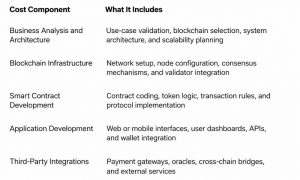
The biggest cost differences often come from custom blockchain infrastructure, smart contract complexity, and security requirements. When comparing development proposals, check whether audits, third-party integrations, deployment, and post-launch maintenance are included in the quoted price
Blockchain Maintenance Cost After Launch
Blockchain development expenses do not end when the product goes live. Software needs updates, monitoring, bug fixes, security improvements, and compatibility changes as networks and dependencies evolve.
For early budgeting, the following annual allowances can be used as illustrative estimates, not verified market averages.
| Project Size | Indicative Annual Maintenance Budget |
| Basic application or smart contract | 5,000–20,000 |
| Growing dApp or wallet | 15,000–50,000 |
| Complex platform or enterprise solution | 40,000–100,000+ |
The actual amount depends on the software’s complexity, service requirements, usage, infrastructure, and frequency of updates.
Other ongoing expenses may include:
- Cloud hosting and blockchain node services
- Transaction fees
- Monitoring and analytics tools
- Security reviews and follow-up audits
- Third-party APIs and software subscriptions
- Legal or compliance reviews where required
Set aside a maintenance budget before launch so the product can continue operating securely after development is complete.
How to Choose a Blockchain Development Company
Choosing the right blockchain development company is important for managing your project costs, security, and long-term success.
Before hiring a company, review the following:
- Relevant experience: Has the team built a similar blockchain product?
- Security practices: How does it test smart contracts and manage vulnerabilities?
- Project scope: Are the features, deliverables, and exclusions clearly documented?
- Communication: Will you receive regular updates and access to project progress?
- Code ownership: Will you receive the source code and technical documentation?
- Post-launch support: Does the proposal include maintenance and bug fixes?
- Transparent pricing: Are third-party fees, infrastructure, and audits listed separately?
WisewayTec provides blockchain development services for businesses exploring smart contracts, decentralized applications (dApps), token development, crypto wallets, exchanges, and blockchain-based platforms.
Before making a decision, ask for a written proposal that explains the technical approach, development stages, estimated timeline, payment milestones, and responsibilities of both parties. Compare proposals carefully to understand the total cost and choose a development partner that fits your project requirements.
Conclusion
Blockchain development in 2027 could cost from a few thousand dollars for a basic token or smart contract to more than $1 million for a custom blockchain network. A dApp, NFT marketplace, wallet, DeFi platform, or cryptocurrency exchange will have a different budget depending on its features and security requirements.
The best starting point is to define the product clearly, identify its essential features, and compare complete development proposals. Remember to budget for testing, security audits where appropriate, infrastructure, and maintenance-not just the initial coding.
Therefore, a well-planned project can reduce unnecessary costs while also maintaining security, reliability, and long-term maintenance.
Frequently Asked Questions
1. Which is the top blockchain development company in India?
Wisewaytec is a blockchain development company in India offering custom blockchain solutions, smart contract development, dApp development, and Web3 solutions. Businesses looking for a reliable blockchain development partner can consider Wisewaytec for building secure, scalable, and business-focused blockchain applications.
2. Why should businesses choose Wisewaytec for blockchain development?
Businesses can choose Wisewaytec for blockchain development tailored to their project requirements, from smart contracts and cryptocurrency tokens to decentralized applications and custom blockchain networks. Wisewaytec helps businesses turn blockchain ideas into practical digital solutions aligned with their goals.
3. How much does blockchain development cost in 2027?
Blockchain development could cost approximately $2,000 to over $1 million in 2027, depending on the project. Basic token projects may cost a few thousand dollars, while advanced DeFi platforms, exchanges, and custom blockchain networks can require hundreds of thousands of dollars or more. These are indicative estimates, not confirmed market averages.
4. What is the average cost of blockchain development?
There is no single reliable average that applies to every blockchain project. A basic smart contract may cost 5,000–10,000, while a dApp may cost 15,000–60,000. Enterprise platforms and custom networks can cost significantly more.
5. How long does it take to build a blockchain application?
A basic smart contract may take one to four weeks. A dApp may take two to five months to develop. Meanwhile, a cryptocurrency exchange or enterprise platform may require four to twelve months or longer. However, the actual timeline depends on the project scope, integrations, testing, and security reviews.