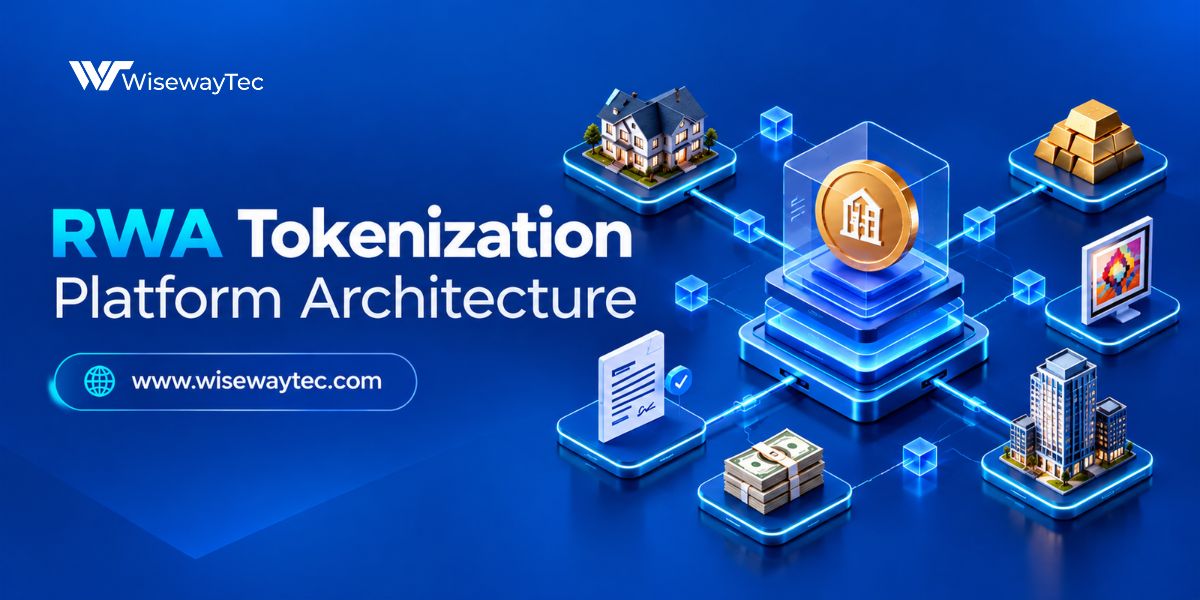
RWA tokenization platform architecture defines how real-world assets, legal ownership rights, blockchain networks, smart contracts, compliance systems, and investor applications work together. It connects off-chain records, such as property documents or financial agreements, with on-chain tokens that represent legally defined ownership interests or other economic rights.
A complete architecture includes asset verification, legal structuring, token issuance, identity checks, custody, oracle integrations, transaction processing, and reporting. Businesses planning an RWA platform should design these components as a single system to support secure transactions, accurate records, regulatory requirements, and reliable asset management.
In this guide, we will go over the main architecture layers, technology choices, development workflow, and security considerations when building an RWA tokenization platform.
Key takeaways
- A token is a record. Its legal meaning comes from the structure and documents behind it, so it does not automatically give title to the asset.
- Split responsibilities on purpose. Legal rights, personal data, and bank payments stay off-chain. Balances, transfer checks, and permissions run on-chain.
- Choose the token standard from the offering structure, not from popularity.
- Oracle freshness, admin keys, and redemption flows are core design problems, not extras.
- Reconcile on-chain balances with your off-chain registry on a schedule.
- Technology supports compliance. Qualified legal counsel decides what compliance requires.
What Is RWA Tokenization Platform Architecture?
Real-world asset (RWA) tokenization refers to a process that represents rights in physical or financial assets by digital tokens on a blockchain, including real estate interests, bonds, private credit, commodities, and certain investment funds.
The architecture of the platform should define the processes of creating (issuance), managing, transferring, and connecting to the underlying assets.
For example, a real estate business can create a legally compliant investment structure and issue blockchain tokens representing interests in this structure. Investors can own or transfer eligible tokens per the rules.
However, a token generally does not grant legal ownership of a property or other physical asset. The legal agreements, ownership records, and applicable laws define the rights the token holder gets.
A well-designed RWA platform therefore needs more than a blockchain and a smart contract. It needs coordinated legal, technical, operational, and compliance systems.
Core Components of an RWA Tokenization Platform
An RWA tokenization platform typically includes the following components.
- Onboarding/Verification of the Asset: Gathering evidence to prove the existence of the asset, ownership of the asset, and if any liens are associated with the asset. Normally involves appraisal reports, titles, custody, and servicing documentation.
- Legal structuring and asset registry: Establishes the investor rights via SPV, trust, fund, or by contract directly. The off-chain registry connects legal claims with investor profiles and wallet addresses.
- Blockchain and settlement infrastructure: The platform where the tokens are issued and transferred, along with nodes, RPC, and indexing, which your services use.
- Smart contracts and token issuance: Contracts that mint, transfer, burn, freeze, and manage roles, in line with the appropriate token standard for the offering.
- Investor identity and compliance: KYC, AML, sanctions check, eligibility, and jurisdiction rules, implemented both back-end and in the token transfer process.
- Custody and key management: Protection of the underlying asset, investor tokens, and privileged admin keys. These are three different problems.
- Oracle and external data integration: Feeds that bring valuations, NAV, reserve attestations, and payment events to contracts and dashboards.
- Backend services, databases, and APIs: The operational core: workflows, document storage, event indexing, reconciliation, notifications, and audit logs.
- Investor portal & admin dashboard: Subscription, holding, document, approval, and compliance activities interface systems
- Money flow & events: Payments, distribution, redemptions, and reporting. Always the boring but risky stuff.
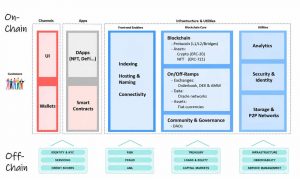
RWA Tokenization Architecture: On-Chain vs. Off-Chain Systems
| Responsibility | Typically on-chain | Typically off-chain |
| Token balances and transfers | ✔ | |
| Transfer eligibility checks | ✔ (reads a status or claim) | ✔ (KYC and eligibility decisions) |
| Role permissions (mint, pause, freeze) | ✔ | ✔ (internal approval workflows) |
| Legal agreements and investor rights | Hash or reference only | ✔ |
| Personal data and KYC documents | Never in raw form | ✔ |
| Valuations and appraisals | Attested value or timestamp | ✔ (source documents) |
| Fiat payments and bank reconciliation | ✔ | |
| Reporting and audit exports | Event logs as input | ✔ |
Established practice: keep personal data off public chains and use on-chain status flags or claims instead. Design choice: where the authoritative ownership record lives and how much logic sits in contracts versus services.
RWA Tokenization Platform Architecture: Layer-by-Layer Breakdown
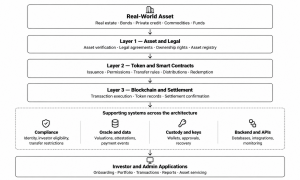
A practical architecture separates responsibilities into layers while allowing them to communicate through controlled interfaces.
Asset and Legal Layer
This layer connects the real-world asset to the rights represented by a token. It contains asset documentation, legal agreements, ownership or issuer records, and supporting verification information.
For example, a property tokenization project may use a legal structure that defines investor interests in a property-owning entity. The legal documentation must clearly explain the rights, restrictions, income distributions, and exit arrangements associated with those interests.
Blockchain and Settlement Layer
The blockchain layer processes token transactions and records state changes. Architects should assess transaction fees, network reliability, finality, throughput, developer tooling, and the availability of suitable wallets and infrastructure.
They should also decide whether transactions require public visibility, restricted participation, or additional privacy controls.
Cross-chain transfers introduce additional complexity because assets and permissions must remain consistent across networks. Bridges and cross-chain messaging systems create extra security and operational risks that should be evaluated before adoption.
Smart Contract and Token Layer
Smart contracts implement token behavior and enforce defined rules.
Depending on the asset and offering, a platform may use separate contracts for token issuance, investor permissions, distributions, and administrative functions. Separating responsibilities can make testing and auditing easier, although it also introduces integration considerations.
Upgradeable contracts may help operators address defects or changing requirements, but upgrade permissions must be carefully governed. Emergency pause functions can limit
Common token standards for RWA projects
| Standard | Typical use | Important consideration |
| ERC-20 | Fungible tokens | Additional controls may be required for restricted investment transfers. |
| ERC-721 | Unique digital tokens | Useful for distinct assets or interests, but does not itself establish legal ownership. |
| ERC-1155 | Multiple token types in one contract | Can support different token categories under a shared contract architecture. |
| ERC-3643 | Permissioned tokenization | Designed for regulated token transfers with identity and eligibility controls. |
| ERC-1400 | Security-token functionality | A family of security-token interfaces and extensions; confirm the specific implementation and compatibility requirements. |
These standards are not interchangeable. The correct choice depends on whether the token represents a unique asset, a fungible investment interest, a restricted security, or another type of right. Technical standards also do not replace legal structuring or regulatory review.
Identity and Compliance Layer
This layer checks whether an investor is permitted to participate in a particular offering or transaction.
A typical flow is:
- The investor submits required identity and eligibility information.
- An approved provider or compliance team completes the applicable checks.
- The platform records an appropriate eligibility status.
- The transfer system checks the required permissions.
- The transaction is allowed or rejected according to the configured rules.
The platform should avoid exposing unnecessary personal information on a public blockchain. It should also define procedures for expired verification, revoked eligibility, sanctions updates, and regulatory reporting.
Oracle and Asset Data Layer
The oracle layer could be used to provide any external information needed by smart contracts or backend services such as asset valuations, reserve audits, or payment confirmations. A good practice implementation would specify who has the authority to post data, how often the data is updated, have procedures for identifying anomalous values, and address the case when data becomes unavailable.
In the context of assets, it is essential to distinguish between the reported value, an independently audited value, and the legally protected claim. These are three separate figures that should be considered different by the software.
Custody and Key Management Layer
The custody layer’s design should specify who is entitled to make any transfers, what approvals are required for administrative functions, and how private keys are stored and protected. For instance, the issuer’s admin wallet could be designed to require multiple approvals for any significant transactions. In turn, the wallets of investors may have unique procedures depending on what custody model is elected.
Privileged activity should be audited and approved at a required level. It may be necessary to conduct periodic tests of key recovery procedures to avoid surprises with actual use cases.
Backend, API, and Application Layer
The application layer connects investors, administrators, and external service providers to the platform.
A typical backend may include:
- An API gateway and authentication service
- An investor and eligibility management service
- An asset and document registry
- A blockchain transaction monitoring service
- A payment and distribution reconciliation service
- Notifications and reporting
- An administrative dashboard and audit logs
A relational database may store operational records, while blockchain data indexing services support transaction history and balances. The backend should reconcile its records with blockchain events and handle transaction failures, retries, and duplicate messages safely.
How an RWA Tokenization Platform Works: Step-by-Step
Consider a hypothetical platform that tokenizes investment interests connected to a legally structured real estate project.
Step 1: Identify and Verify the Asset
The issuer collects property records, valuation documents, and other evidence required for the project. Appropriate professionals verify the information and identify any ownership or legal issues.
Step 2: Establish the Legal Structure
The issuer defines the investment rights, investor obligations, transfer restrictions, distribution terms, and redemption or exit arrangements. The legal structure determines what the token represents.
Step 3: Complete Investor Onboarding
Prospective investors complete the applicable identity and eligibility checks. The platform records whether they can participate in the offering and under what conditions.
Step 4: Configure and Test Smart Contracts
Developers implement token issuance, transfer controls, administrative roles, and other required functions. The contracts are tested and independently audited according to the project’s risk profile.
Step 5: Authorize Token Issuance
The issuer confirms that the required legal, operational, and asset-verification conditions have been met. Authorized personnel then initiate issuance under the approved process.
Step 6: Distribute Tokens to Eligible Investors
Tokens are allocated to eligible investors according to the offering terms. The platform records transaction details and updates its application data.
Step 7: Manage Transfers and Settlement
When an investor initiates a transfer, the platform checks the applicable restrictions. If the transaction satisfies the required rules, the smart contract processes it and records the result.
Step 8: Manage Distributions, Redemptions, and Reporting
The platform coordinates relevant payments, investor notifications, reporting, and redemption or other exit events according to the legal structure. The underlying asset’s performance and token records should be reconciled as required.
This workflow illustrates why successful RWA tokenization depends on both blockchain execution and off-chain legal and operational processes.
Recommended Technology Stack for RWA Platform Development
The technology stack should follow the project’s requirements rather than being selected solely because a particular tool is popular.
| Component | Example technologies | Main purpose |
| Smart contracts | Solidity, compatible development frameworks | Implement issuance and transfer rules |
| Blockchain | Ethereum or suitable EVM-compatible networks | Record token transactions and execute contracts |
| Token standards | ERC-20, ERC-721, ERC-1155, ERC-3643, applicable ERC-1400 implementations | Define token behavior and interfaces |
| Backend | Node.js, TypeScript, Python, or Java | Manage business logic and integrations |
| Database | PostgreSQL or another suitable database | Store operational records and metadata |
| Blockchain integration | Web3 libraries, RPC providers, indexing services | Submit transactions and monitor blockchain activity |
| Identity and compliance | Appropriate KYC/AML and screening providers | Support required identity and eligibility checks |
| Oracle infrastructure | Suitable oracle networks or controlled data integrations | Deliver external data to applications |
| Custody | Wallet infrastructure, multisignature controls, MPC or HSM solutions | Protect digital assets and privileged keys |
| Cloud and monitoring | Suitable cloud services, logging, alerting, and security monitoring | Operate and maintain the platform |
The final selection depends on transaction volume, asset type, privacy, budget, jurisdiction, integration needs, and security requirements. Each external provider should be evaluated for reliability, support, security controls, and operational dependencies.
Security and Compliance Considerations
The controls related to security and compliance should be designed into the platform’s architecture, not installed in an ad hoc manner before launch.
Smart contract security: Test expected and edge cases, access restrictions, issuance, and redemptions. Independent third-party audits should be considered if applicable, and a response protocol established for the smart contract vulnerabilities that are discovered.
Key management: Restrict sensitive functions, separate operator roles, protect keys, and test recovery scenarios. Highly impactful operations should require specific approval processes.
Oracle reliability: Test and verify the validity of the source of data, check for unexpected updates, set data freshness requirements, and ensure there are alternative providers in the case of a failure.
Privacy and data protection: The contents of confidential or personal nature should be kept off the public blockchain whenever possible. Appropriate access controls and retention should be in place for data stored on private blockchains.
Enforceability and legal nature of tokens: Legal documentation should align with the on-chain representation of assets, and ownership terms, rights, restrictions, and redemption processes should be well-documented.
Regulatory compliance: Securities laws, investor eligibility criteria, anti-money laundering regulations, licensing requirements, custodianship, personal data protection laws, and other relevant regulations should be reviewed by qualified local counsel for the relevant jurisdictions, depending on the proposed structure and assets.
Operational resilience: Transaction processing and settlement infrastructure should be monitored, and procedures for auditing, incident response, and business continuity should be established and tested.
A technically secure token does not automatically make the underlying investment safe or legally compliant. The full system must be assessed.
How to Build an RWA Tokenization Platform
A well-defined development process enables project teams to design a fit-for-purpose RWA tokenization platform.
For a practical project roadmap, review these steps to launch an RWA tokenization project, from initial planning through implementation.
Requirements analysis: Determine the type of asset, users, jurisdiction, transactions, and business goals.
Legal and compliance: Specify the rights, restrictions, investor eligibility, and obligations.
Architecture design: Choose between blockchain platforms, token models, custody, integrations, and on-chain/off-chain processes.
Prototype development: Build a proof-of-concept to test core processes.
Smart contract development: Program issuance logic, permissions, transactions, APIs, dashboards, and 3rd-party services.
Testing and auditing: Simulate business processes, integration problems, access control, and smart contract weaknesses.
Launch and maintenance: Set deployment rules, governance processes, monitoring, and support systems.
The final solution’s cost, timeline, and complexity depend on the selected assets, number of platforms involved, legal jurisdiction, and level of automation.
Conclusion: Building a Secure RWA Tokenization Platform
The RWA tokenization platform architecture combines blockchain technology, smart contracts, legal rights, investor validation, custody, outside data, and business application layers. Every layer performs its own function, yet all of them have to work together in order to provide reliable issuance, eligible transfer, proper record-keeping, and asset life cycle management.
The architecture design begins with proper assessment of the asset and its rights. After that, the organizations can choose the suitable technology and develop the platform architecture accordingly.
Before implementation, businesses should also understand the RWA tokenization platform development cost based on their asset type, compliance requirements, technology choices, and required features.
Planning to build an RWA tokenization platform? Contact WisewayTec to discuss your blockchain development requirements, architecture planning, and potential implementation approach.
Frequently Asked Questions
1. Does WisewayTec provide RWA tokenization platform development services?
WisewayTec can provide blockchain development services for companies that are interested in exploring Web3 solutions. Please contact the company to discuss your requirements for RWA tokenization platform development, including architecture design, smart contract development, and blockchain integration.
2. Can WisewayTec help design an RWA tokenization platform architecture?
The company can consult on your project requirements and propose an architecture for an RWA tokenisation platform, including blockchain selection, smart contract development, backend integration, and platform capabilities.
3. What is RWA tokenization platform architecture?
At the same time, RWA tokenization platform architecture refers to a design in which general real-world assets are connected to blockchain tokens; this connection relies on asset-related data, legal rights, smart contracts, investor verification, custodianships, oracles, back-end services, and applications that are organized in a system for issuing tokens and managing post-issuance events.
4. Which blockchain is best for RWA tokenization?
There are no best blockchains for RWA tokenization – the choice should be made considering transaction costs, speed, security, privacy, interoperability, and regulation. Organizations should consider which blockchain will best suit their needs and what type of transactions they will execute, be it public or permissionless chains.
5. Which smart contract standards are used for RWA tokenization?
The possible solutions include ERC-20 for fungible tokens, ERC-721 for non-fungible tokens, ERC-1155 for multi-tokens, and ERC-3643 for permissioned tokenization. The implementation of ERC-1400 can be appropriate in case of security tokens. It all depends on the asset and the structure of the offering.