
Quick Answer: Choosing the right blockchain depends on what you are building. Ethereum is the best blockchain for DeFi protocols, security tokens, and enterprise applications that require maximum security and institutional trust — it holds 56.4% of all DeFi TVL ($54.4 billion) and has 31,869 active developers. Solana is the best blockchain for high-speed consumer applications, gaming, and payment systems — processing 600–4,000 TPS at under $0.01 per transaction. BNB Chain is the best blockchain for cost-sensitive token launches, GameFi, and high-volume consumer dApps — offering EVM compatibility with 10–20x lower gas fees than Ethereum and 4 million+ daily active users. For projects that need multi-chain deployment, a blockchain development company like WisewayTec builds across all three platforms.
Ethereum vs Solana vs BNB Chain: Head-to-Head Comparison
| Metric | Ethereum | Solana | BNB Chain |
|---|---|---|---|
| Network metrics | |||
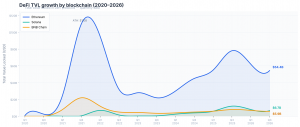
| DeFi TVL | $54.4B (56.4%) | $6.7B | $5.9B |
| Market cap | ~$233–330B | ~$47B | ~$85B |
| Daily active users | 9.3M (monthly) | 1.75–2M | 4M+ (BSC + opBNB) |
| Stablecoin supply | $147B | ~$5B | ~$6.5B |
| Validators | 890,000+ | ~800 | 21 |
| Performance | |||
| Real-world TPS | 15–30 (L1) | 600–4,000 | ~213 |
| Avg gas fee (swap) | $2–$10 (L1) | <$0.01 | $0.05–$0.30 |
| L2 ecosystem TVL | $27–45B | None (native) | opBNB |
| Development | |||
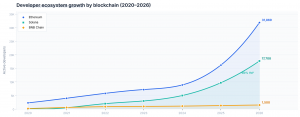
| Active developers | 31,869 | 17,708 | ~1,500 |
| Smart contract language | Solidity | Rust | Solidity (EVM) |
| EVM compatible | ✓ native | ✗ | ✓ full |
| Dev cost (basic contract) | $700–$12K | $1.5K–$15K | $500–$10K |
| Best for | |||
| Primary use cases | DeFi Enterprise RWA Security tokens |
High-speed apps Gaming Payments Consumer |
Token launches GameFi Budget dApps Meme tokens |
Why This Comparison Matters in 2027
The global blockchain technology market reached USD 47.96 billion in 2026 and is projected to reach USD 577.36 billion by 2034 at a CAGR of 36.50%. Every blockchain project — whether a DeFi protocol, an NFT marketplace, a token launch, or an enterprise supply chain solution — begins with a platform decision. That decision determines the project’s transaction speed, gas costs, developer talent pool, security guarantees, ecosystem integrations, and long-term scalability.
Choosing the wrong blockchain is not just a technical mistake — it is a business mistake. Building a high-frequency trading application on Ethereum mainnet means paying $2–$10 per swap when Solana charges under $0.01. Launching a DeFi protocol on BNB Chain means operating with 21 validators instead of Ethereum’s 890,000+. Deploying a GameFi platform on Solana means missing BNB Chain’s 4 million daily active users who already transact in gaming-heavy environments.
This guide provides the data-driven framework to make that decision correctly. Every recommendation below is backed by verified on-chain data from September–October 2026, sourced from DefiLlama, Electric Capital, and CoinCentral. For companies that build across all three platforms, see the full ranked comparison of blockchain development companies in India.
Ethereum — The Security and DeFi Standard
Ethereum is the largest programmable blockchain by every measure of economic value. It holds $54.42 billion in DeFi TVL (56.4% of all DeFi value globally) as of September 2026. It carries $147 billion in stablecoin supply — more than all other chains combined. It has 31,869 active developers, nearly double the next largest ecosystem. And it is secured by over 890,000 validators — making it the most decentralized and attack-resistant blockchain in production.
Ethereum’s dominance is not just about size — it is about trust. When BlackRock launched its BUIDL tokenized treasury fund, it chose Ethereum. When Franklin Templeton expanded its on-chain fund products, it chose Ethereum. When the EU’s MiCA regulatory framework defined compliance standards for digital assets, Ethereum’s infrastructure was the reference architecture. This institutional adoption creates a self-reinforcing cycle: more institutional capital attracts more developers, which produces more protocols, which draws more capital.
Ethereum’s Strengths
Largest DeFi ecosystem by a factor of 8x. Ethereum’s $54 billion in DeFi TVL dwarfs Solana’s $6.7 billion and BNB Chain’s $5.9 billion. Every major DeFi protocol — Aave, Uniswap, Lido, MakerDAO, Compound — was built on Ethereum first. This means the deepest liquidity pools, the most battle-tested smart contracts, and the broadest composability between protocols.
Most developers and most tooling. With 31,869 active developers and 8,000 monthly active contributors across 231,000 repositories, Ethereum has the richest development ecosystem in blockchain. Solidity is the most widely taught blockchain programming language, and tools like Hardhat, Foundry, OpenZeppelin, Ethers.js, and Wagmi make Ethereum development faster and more standardised than any alternative.
Maximum decentralisation and security. Ethereum’s 890,000+ validators make it practically impossible to attack through a 51% consensus manipulation. No other blockchain comes close — Solana has approximately 800 validators, and BNB Chain operates with just 21.
Layer 2 solves the speed and cost problem. Ethereum’s historical weakness — slow transactions and expensive gas — has been substantially addressed by Layer 2 networks. Base, Arbitrum, and Optimism collectively hold $27–45 billion in TVL and process over 5x more transactions than Ethereum’s base layer. Transactions on Layer 2 networks cost under $0.10 while inheriting Ethereum’s security guarantees.
Ethereum’s Weaknesses
High gas fees on mainnet. A simple token swap on Ethereum L1 costs $2–$10 in gas fees. For applications with high transaction volume — gaming, micropayments, social platforms — this is economically prohibitive on mainnet. Layer 2 networks solve this, but they add architectural complexity.
Slow base-layer throughput. Ethereum processes 15–30 transactions per second on L1 — compared to Solana’s 600–4,000 TPS. Applications that need real-time responsiveness (order books, live games, instant payments) struggle on Ethereum mainnet without L2 infrastructure.
Build on Ethereum When
Ethereum is the right blockchain for DeFi protocols that need deep liquidity and composability, security tokens and RWA tokenisation that require institutional trust, enterprise blockchain applications that demand maximum decentralisation, and any project where the value locked justifies higher gas costs. If security, ecosystem depth, and institutional credibility matter more than raw speed, Ethereum is the answer.
Solana — Speed and Consumer Scale
Solana is the fastest major blockchain in production. It processes 600–4,000 real transactions per second at a cost of less than $0.01 per transaction — roughly 1,000x cheaper than Ethereum mainnet and 10x cheaper than BNB Chain. This speed and cost profile makes Solana the natural platform for applications where every millisecond and every fraction of a cent matters.
Solana’s developer ecosystem is growing faster than any other chain. Industry data recorded 17,708 active developers on Solana in 2025 — an 83% year-over-year increase, the highest growth rate among major blockchains. The Solana Foundation’s developer programs, hackathons, and grants have attracted a new generation of builders focused on consumer-facing applications, high-frequency DeFi, and blockchain gaming.
Solana’s Strengths
Unmatched transaction speed. Solana’s 600–4,000 TPS with sub-second finality makes it the only L1 blockchain capable of supporting real-time applications without Layer 2 intermediaries. High-frequency trading bots, live games, and payment processing systems all benefit from this native speed.
Near-zero transaction costs. At under $0.01 per transaction, Solana eliminates gas as a barrier to adoption. Consumer applications can process thousands of microtransactions without economic friction — something impossible on Ethereum mainnet and impractical even on BNB Chain for very high volumes.
Fastest-growing developer ecosystem. Solana’s 83% year-over-year developer growth outpaces every other blockchain. The ecosystem has expanded particularly in consumer applications, payments, and DeFi — attracting developers from both traditional tech and the Ethereum ecosystem.
Solana’s Weaknesses
Network stability concerns. Solana has experienced multiple network outages and performance degradation events since its launch. While the network has become more stable, this history creates risk perception for projects that require 100% uptime — particularly financial applications handling significant value.
Smaller DeFi ecosystem. Solana’s $6.7 billion TVL is roughly 12% of Ethereum’s $54 billion. The liquidity depth, protocol diversity, and composability options are significantly narrower. DeFi protocols on Solana face thinner liquidity pools and fewer integration partners.
Rust programming requirement. Solana development requires Rust and the Anchor framework — languages with a steeper learning curve and a smaller developer pool than Solidity. This affects both development cost (Rust developers command higher rates) and the availability of ready-made libraries and templates.
Developer retention volatility. Despite strong growth overall, Solana experienced a 40% drop in weekly active developers in March 2026. This volatility suggests the ecosystem is still maturing and retaining developers less consistently than Ethereum.
Build on Solana When
Solana is the right blockchain for high-speed trading platforms and DeFi applications, consumer-facing apps that need instant transactions at near-zero cost, blockchain games requiring real-time responsiveness, payment and micropayment systems, and any project where speed and low fees outweigh the need for maximum decentralisation.
BNB Chain — The Affordable EVM Workhorse
BNB Chain is the most actively used blockchain by daily users. With 4 million+ daily active users across BSC and opBNB combined, BNB Chain processes more daily transactions from more unique wallets than either Ethereum mainnet or Solana . The network holds $5.9 billion in DeFi TVL, 700 million+ cumulative unique addresses, and dominates GameFi with over 40% of all EVM-chain gaming TVL.
BNB Chain’s core advantage is pragmatic: it runs the same Solidity code as Ethereum but at 10–20x lower gas fees. This means developers and businesses already building on Ethereum can deploy to BNB Chain with minimal code changes, reaching a different audience at a fraction of the operating cost. For token launches, meme tokens, gaming platforms, and consumer dApps that prioritise user volume over maximum decentralisation, BNB Chain offers the most cost-effective entry point.
BNB Chain’s Strengths
Highest daily active users of any blockchain. BNB Chain’s 4M+ DAU exceeds Solana (~1.8M) and Ethereum mainnet (~9.3M monthly, lower on a daily basis). This user base is heavily concentrated in gaming, NFT trading, and retail DeFi — making BNB Chain the default platform for applications that need large consumer audiences.
EVM compatibility = Ethereum portability. BNB Chain runs on the EVM (Ethereum Virtual Machine), meaning any Solidity smart contract written for Ethereum can be deployed on BNB Chain with minimal modification. Developers do not need to learn a new language. Existing Ethereum tools (Hardhat, Remix, MetaMask) work natively. This dramatically reduces migration cost and development overhead.
10–20x lower gas than Ethereum mainnet. Average gas fees on BNB Chain range from $0.05 to $0.30 per transaction — significantly cheaper than Ethereum L1 ($2–$10) while remaining slightly more expensive than Solana (<$0.01). For most consumer-facing applications, this fee level is economically viable without the complexity of Layer 2 architecture.
GameFi dominance. BNB Chain holds over 40% of GameFi TVL among EVM-compatible chains and hosts 2,000+ leading dApps by daily active users. If the project is a blockchain game or a gaming-adjacent platform (in-game currencies, NFT marketplaces for gaming assets, play-to-earn infrastructure), BNB Chain has the largest existing user base in this vertical.
BNB Chain’s Weaknesses
Centralisation risk. BNB Chain operates with only 21 validators under a Proof of Staked Authority (PoSA) consensus mechanism — compared to Ethereum’s 890,000+ and Solana’s ~800. This makes BNB Chain significantly more centralised, creating governance risk and potential censorship concerns for applications that require censorship-resistant infrastructure.
Smaller developer community. With approximately 1,500 active developers (1,100 full-time), BNB Chain’s development ecosystem is considerably smaller than Ethereum’s 31,869 or Solana’s 17,708. Fewer developers means fewer open-source libraries, fewer audited contract templates, and a smaller pool of talent available for hire.
Binance association and regulatory perception. BNB Chain’s close association with Binance creates regulatory perception risk in certain jurisdictions. While BNB Chain operates as a technically independent network, regulatory actions against Binance in some markets can affect the perceived stability of the chain.
Build on BNB Chain When
BNB Chain is the right blockchain for cost-sensitive token launches that need affordable gas, GameFi and gaming applications that want the largest existing gaming user base, consumer dApps migrating from Ethereum that need lower operating costs without learning a new language, meme token launches and community-driven projects where transaction cost matters more than decentralisation, and high-volume applications where BNB Chain’s 4M+ DAU provides immediate distribution.
Which Blockchain for Which Project Type? (Decision Matrix)
This decision matrix maps common project types to the blockchain that best fits their requirements:
DeFi Protocol (Lending, DEX, Yield): Ethereum — deepest liquidity, most composability, institutional trust
Security Token / RWA Tokenisation: Ethereum — regulatory credibility, ERC-1400 standard, institutional adoption
Enterprise Blockchain Network: Ethereum (or Hyperledger) — maximum decentralisation, proven enterprise tooling
High-Frequency Trading Platform: Solana — 600–4,000 TPS, sub-second finality, <$0.01 fees
Blockchain Game / GameFi: BNB Chain — 40%+ GameFi TVL share, 4M+ daily users, or Solana for speed-first games
NFT Marketplace: Ethereum for premium collections, Solana for high-volume/affordable minting
Token Launch (Budget-Sensitive): BNB Chain — lowest deployment + gas cost with EVM compatibility
Consumer / Social dApp: Solana — near-zero fees, instant transactions, growing consumer developer community
Payment / Micropayment System: Solana — sub-cent transaction fees at scale
Cross-Chain / Multi-Chain Project: Build on 2+ chains — a blockchain development company like WisewayTec deploys across Ethereum, Solana, BNB Chain, Polygon, and Hyperledger
Development Cost Comparison: Ethereum vs Solana vs BNB Chain
The blockchain you choose affects development cost in three ways: smart contract development rates (driven by language and talent availability), deployment and gas costs (chain-specific), and ongoing operational expenses.
Smart Contract Deployment Cost:
Ethereum (Solidity): $700–$12,000 depending on complexity · Deployment gas: $50–$500+ on mainnet, <$1 on L2
Solana (Rust/Anchor): $1,500–$15,000 · Deployment: <$1 in SOL
BNB Chain (Solidity): $500–$10,000 · Deployment: $1–$10 in BNB
Developer Hourly Rates:
Solidity developer (Ethereum/BNB Chain): $25–$85/hr
Rust developer (Solana): $40–$120/hr (smaller talent pool = higher rates)
Ongoing Gas / Operational Cost (per 10,000 transactions):
Ethereum L1: $20,000–$100,000 · Ethereum L2: $100–$1,000
Solana: $1–$10
BNB Chain: $500–$3,000
The cost differential is significant. A dApp processing 10,000 daily transactions would spend roughly $100,000+ per year on Ethereum mainnet gas, $3,000–$30,000 on BNB Chain, and under $100 on Solana. This operational cost analysis is often more important than the initial development cost in determining the right blockchain.
For a detailed breakdown of blockchain development pricing across all platforms, read the complete guide on blockchain development cost in India.
2027 Trend: Multi-Chain Is the Real Answer
The most successful blockchain projects in 2027 will not be single-chain products. They will deploy across two or more blockchains to capture different user segments, optimise for different cost profiles, and reduce platform dependency risk.
This is not a theoretical prediction — it is already happening. Uniswap operates on Ethereum, Polygon, Arbitrum, Optimism, Base, BNB Chain, and Avalanche. Aave runs on Ethereum, Polygon, Arbitrum, Optimism, and Avalanche. PancakeSwap started on BNB Chain and expanded to Ethereum, Arbitrum, and Base. The pattern is clear: protocols that start on one chain and expand to others capture more liquidity, more users, and more revenue than single-chain competitors.
For businesses planning a blockchain project in 2027, the practical implication is that the blockchain development partner matters more than the initial chain selection. A blockchain development company with multi-chain expertise — capable of deploying across Ethereum, Solana, BNB Chain, Polygon, and Hyperledger — gives the project flexibility to expand without switching vendors or rebuilding from scratch.
WisewayTec builds across all five major blockchain platforms, enabling clients to launch on the chain that fits their initial requirements and expand to additional chains as the project scales. This multi-chain approach eliminates the “which blockchain” question by turning it into a sequencing decision rather than a permanent commitment.
Frequently Asked Questions
Which blockchain is best for building in 2027?
The best blockchain depends on the project type. Ethereum is best for DeFi, security tokens, and enterprise applications requiring maximum security ($54.4B TVL, 890,000+ validators). Solana is best for high-speed consumer apps and gaming (600–4,000 TPS, <$0.01 fees). BNB Chain is best for affordable token launches and GameFi (4M+ daily users, EVM compatible). Most successful projects in 2027 will deploy on two or more chains.
Is Ethereum or Solana better for DeFi?
Ethereum is significantly better for DeFi in 2027. It holds $54.4 billion in DeFi TVL — roughly 8x more than Solana’s $6.7 billion. Ethereum has deeper liquidity pools, more composable protocols, and stronger institutional trust. Solana is better suited for DeFi applications that prioritise transaction speed over liquidity depth, such as high-frequency trading and perpetual DEXes.
Which blockchain has the lowest fees?
Solana has the lowest fees at under $0.01 per transaction. BNB Chain averages $0.05–$0.30. Ethereum mainnet costs $2–$10 per swap, though Ethereum Layer 2 networks (Base, Arbitrum, Optimism) reduce this to under $0.10 while maintaining Ethereum’s security guarantees.
Is BNB Chain safe to build on?
BNB Chain is technically reliable but more centralised than Ethereum or Solana, operating with only 21 validators under a Proof of Staked Authority consensus. This makes it less censorship-resistant. BNB Chain is safe for consumer applications, gaming, and token launches where decentralisation is a lower priority than cost and user reach. For applications handling very large financial value or requiring maximum censorship resistance, Ethereum is the safer choice.
Which blockchain has the most developers?
Ethereum leads with 31,869 active developers — nearly double Solana’s 17,708 and approximately 21x BNB Chain’s ~1,500 (Source: Electric Capital Developer Report, 2025). Ethereum also has the most mature tooling ecosystem with Hardhat, Foundry, OpenZeppelin, and comprehensive documentation.
How much does it cost to deploy a smart contract on each blockchain?
Deploying a basic smart contract costs $50–$500+ in gas on Ethereum mainnet (under $1 on Layer 2), under $1 in SOL on Solana, and $1–$10 in BNB on BNB Chain. Development cost (writing the contract) ranges from $700–$12,000 for Solidity (Ethereum/BNB Chain) and $1,500–$15,000 for Rust (Solana) — Rust developers command higher rates due to a smaller talent pool.
Can you build on multiple blockchains at the same time?
Yes. Multi-chain deployment is the dominant strategy for successful blockchain projects in 2027. WisewayTec builds across Ethereum, Solana, BNB Chain, Polygon, and Hyperledger — enabling clients to launch on one chain and expand to others without switching vendors or rebuilding smart contracts.
Which blockchain is best for token development?
For maximum ecosystem compatibility and DeFi integration, launch an ERC-20 token on Ethereum. For budget-friendly launches with EVM compatibility, use BNB Chain (BEP-20). For high-speed, low-cost token utility, deploy an SPL token on Solana. The best crypto token development companies build across all three standards. Read the full comparison of blockchain development companies for companies that support multi-chain token deployment.