




Over $3.4 billion worth of cryptocurrency was stolen in 2025, making it one of the costliest years for crypto-related theft on record. One of the largest exchange breaches alone resulted in nearly $1.5 billion in losses, highlighting the risks associated with traditional custodial exchange models and reinforcing the industry’s demand for more secure trading infrastructure.
These incidents have fundamentally changed how businesses, investors, and regulators evaluate cryptocurrency exchanges. Today, fast trade execution and deep liquidity are no longer enough. Users expect greater control over their digital assets, institutions require stronger compliance and transparency, and businesses need platforms that can deliver security without compromising performance.
This is exactly why Hybrid Crypto Exchanges have emerged as one of the fastest-growing exchange models in 2026. By combining the speed and liquidity of centralized exchanges with the self-custody, transparency, and security of decentralized finance, hybrid platforms offer a balanced approach that addresses the limitations of traditional exchange models.
With the rise in demands for safe and scalable trading platforms, many companies are opting to form a business relationship with a hybrid crypto exchange development company that can develop an exchange that will be prepared for the future and comply with user demands. If you run a startup that is developing its very first trading platform or an enterprise that needs to launch its digital asset business, picking the proper partner is of great importance now.
What Is a Hybrid Crypto Exchange?
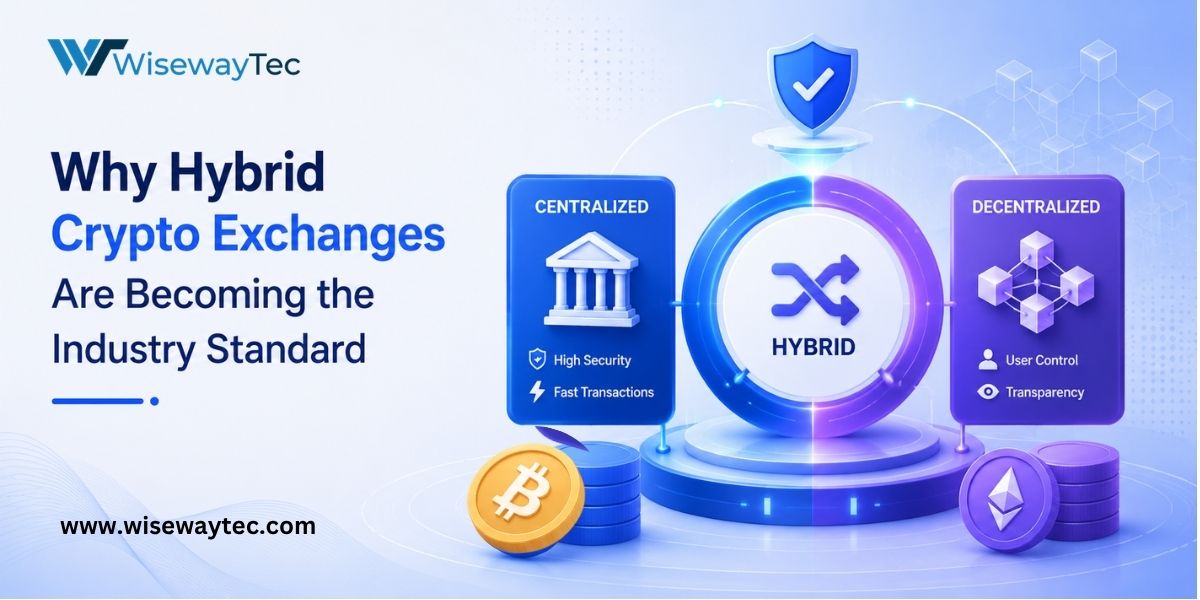
A hybrid crypto exchange is a trading platform that combines the order-matching speed of a centralized exchange (CEX) with the self-custody and transparency of a decentralized exchange (DEX). Instead of forcing users to choose one model, it blends both.
In practice, this means:
- Trade orders are matched off-chain, using a centralized engine, so execution is fast.
- Asset settlement and custody happen on-chain, so users retain control of their private keys.
- Users get a familiar, app-like trading interface without handing full custody of their funds to the platform.
Industry analysts increasingly call this approach “CeDeFi”—a shorthand for centralized-decentralized finance. It’s not a niche experiment anymore; it’s becoming the default architecture for new exchange builds.
How Does a Hybrid Exchange Work?

A hybrid exchange typically separates two things that a traditional CEX bundles together: order execution and asset settlement.
Matching of off-chain orders
Orders are matched via a centralized matching engine, similar to a traditional stock exchange. This keeps latency to a minimum and allows the platform to handle high volumes of trading without clogging a blockchain network.
On-Chain Settlement & Custody
Once a trade has been matched, settlement occurs on-chain, via either smart contracts or non-custodial wallet integrations. This means the exchange never has full control over user funds the way a pure CEX does, which drastically reduces the “single point of failure” risk that has caused some of the biggest losses in the industry.
Smart Contract Automation
Smart contracts increasingly handle escrow, automated compliance checks, and trade settlement logic, reducing manual intervention and human error.
Cross-Chain and Multi-Chain Support
Because user assets are now spread across Ethereum, Solana, BNB Chain, Polygon, and newer Layer 2 networks, modern hybrid platforms are built with cross-chain interoperability from day one, letting users trade across chains without manually bridging assets.
Key Features of a Modern Hybrid Crypto Exchange
A well-built hybrid exchange in 2026 typically includes:
- Non-custodial wallet integration – users hold their own keys while still trading on a fast matching engine.
- Hybrid order books – off-chain speed, on-chain verifiability.
- Multi-chain asset support – trading across several blockchains without external bridges.
- Risk and fraud detection using AI – identifying anomalies in deposits and transactions in real time
- Ready-to-use blockchain features – the ability to deposit, stake, earn from farming, and lend via the trading screen
- No KYC/AML plugins required – automated identification and transaction monitoring at the core of the system
- Level 2 scaling solutions – reduced transaction costs and faster finality
- APIs on the institutional level – for algorithm trading, liquidity and custody partnerships
Centralized vs Decentralized vs Hybrid Exchange: A Direct Comparison
| Feature | Centralized Exchange (CEX) | Decentralized Exchange (DEX) | Hybrid Exchange |
| Asset custody | Platform holds user funds | User holds private keys | User retains control; platform doesn’t fully custody funds |
| Trade speed | Very fast (off-chain matching) | Slower, depends on blockchain speed | Fast (off-chain matching + on-chain settlement) |
| Liquidity | Generally high | Often fragmented across pools | High, with cross-chain liquidity aggregation |
| User experience | Simple, app-like | Can be complex for beginners | Simple interface with self-custody options |
| Security risk | Higher (single point of failure) | Lower custodial risk, smart contract risk exists | Reduced custodial risk, layered security model |
| Regulatory compliance | Fully regulated, KYC/AML enforced | Often minimal or no KYC | Built for compliance with flexible governance layers |
This is exactly why the line between CEX and DEX is blurring. Analysts now describe this convergence as the “CeDeFi” model, where platforms borrow the strengths of both rather than compete on one axis alone.
Why Businesses Are Adopting Hybrid Exchanges in 2026
1. Security Failures Have Made Custodial Risk Unacceptable
The numbers explain the urgency. Chainalysis recorded roughly $3.4 billion in cryptocurrency theft from crypto platforms between January and early December 2025, and the Bybit exchange breach alone accounts for about $1.5 billion of that total. PeckShield put the full-year 2025 figure even higher, at around $4.04 billion in losses from hacks and scams. Several trackers also confirmed something notable: centralized service breaches overtook DeFi protocol losses for the first time since 2020, mostly because of private key and multisig compromises, not smart contract bugs.
For exchange operators, this data point matters more than any marketing pitch; full custodial control has become a liability, not just an operational duty. Hybrid architecture, where the platform never holds complete custody of user assets, directly reduces that exposure.
2. Regulatory Pressure Is Rewarding Auditable Systems
Regulators in major markets are pushing for clearer compliance, auditability, and user protection standards. Frameworks like the EU’s MiCA and the evolving US stablecoin legislation are pressuring exchanges to prove they can be audited and held accountable. Hybrid exchanges, with on-chain settlement, offer a more natural audit trail, which pure CEX models struggle to match.
3. Institutional Capital Demands Both Trust and Control
When the institutional players enter crypto in 2026, they will need a lot of liquidity, algorithmic trading, and controls on risk. However, institutional players do not want to put their big positions in one single custodial point of failure. Hybrid exchanges are in a good position to serve this part of the institutional capital market because they offer execution that meets institutional standards and an improved custody risk.
4. Users Now Expect Both Speed and Ownership
Retail users have also changed. After watching high-profile exchange collapses and breaches, traders are no longer willing to fully trust a platform with their funds — but they still want the speed and usability of a CEX. Hybrid crypto exchanges are the practical answer to that shift in expectation.
5. DeFi Features Are Now Commodities
Staking, lending, and yield services are no longer the exclusive property of DeFi systems since various trading platforms have already adopted them, while the use of hybrid architecture makes it easier to implement these services rather than simply inserting DeFi solutions into non-DeFi applications.
Also Read: Hybrid Exchanges Are Dominating 2026: Here’s Why (and How to Build One)
Challenges of Building and Running a Hybrid Exchange
Hybrid exchanges are not without complications. Typical difficulties include the following:
- Complex architecture – the use of both off-chain matching engines and on-chain settlement components demands much more engineering effort than a single-model exchange.
- Regulatory uncertainty across regions – compliance rules vary by jurisdiction, and hybrid solutions must be able to adjust.
- Smart contract risks – while custodial risk decreases, susceptibility of smart contracts remains a real problem if they are not audited properly.
- Liquidity fragmentation – combining liquidity from several chains and pools requires advanced routing methods.
- User education – a lot of users do not know what self-custody wallets are and need clear guidelines for using hybrid solutions.
A capable development partner typically addresses these through rigorous smart contract audits, modular architecture, and phased rollouts rather than trying to launch every feature at once.
Security and Compliance: The Non-Negotiables
Given the scale of losses across the industry, security can’t be an afterthought. A serious hybrid exchange build should include:
- Multi-layered custody, combining cold storage, multi-signature wallets, and non-custodial options.
- Independent smart contract audits before mainnet deployment.
- Real-time AI-based transaction monitoring to flag anomalous withdrawal patterns.
- KYC/AML compliance modules aligned with the jurisdictions the platform intends to operate in.
- Bug bounty programs to catch vulnerabilities before malicious actors do.
Given that private key and multisig compromises — not smart contract bugs — drove the largest exchange losses in 2025, custody architecture deserves as much attention as code audits.
Technology Stack Behind a Hybrid Crypto Exchange
A typical hybrid exchange build includes:
- Blockchain layer: Ethereum, Solana, BNB Chain, Polygon, or a custom layer 2, depending on target throughput and cost.
- Matching engine: high-performance, off-chain, built for low-latency order execution.
- Smart contracts: for settlement, escrow, staking, and automated compliance logic.
- Wallet infrastructure: non-custodial wallet SDKs alongside optional custodial options for less experienced users.
- APIs: for algorithmic trading, market data, and institutional integrations.
- AI/ML modules: for fraud detection, risk scoring, and trade analytics.
- Cross-chain bridges or interoperability protocols: to support multi-chain trading without manual asset transfers.
Why 2026 Is the Turning Point
A few forces are converging at once: repeated, high-value custodial breaches have made pure CEX risk visible to everyone; regulators are demanding auditability; institutions are entering the market at scale; and users have simply grown more sophisticated about where they park their assets. Hybrid architecture is the model that answers all four pressures simultaneously, which is exactly why it’s shifting from “innovative option” to “industry standard” in 2026.
WisewayTec: Your Hybrid Crypto Exchange Development Partner
WisewayTec helps startups and enterprises build secure, scalable, and feature-rich hybrid crypto exchanges. With expertise in crypto exchange development, smart contract development, multi-chain integration, and compliance-ready solutions, we deliver high-performance trading platforms designed for long-term growth, security, and scalability.
Conclusion
Hybrid crypto exchanges are not simply an emerging trend; they are a glimpse into the future of the digital asset trading industry. By merging the speed and efficiency of centralized exchanges with the security, transparency, and control aspects of decentralized platforms, these exchanges offer businesses a scalable solution to meet market needs and legal requirements.
With the continuing expansion of the cryptocurrency market, the adoption of hybrid exchange practices has changed from a competitive edge to a matter of strategic investment in the future growth of a company. By using this approach, companies will be able to gain users’ trust and attract investors.
If you want your trading platform to be secure, powerful, and convenient, it is important to find a team of professionals who have experience in hybrid crypto exchange development. WisewayTec is a company that assists startups and international corporations in developing their own hybrid crypto exchanges with all the necessary features.
Whether you’re starting from scratch or upgrading an existing platform, our team can help turn your vision into a reliable and future-ready crypto exchange.
Frequently Asked Questions
What is a hybrid crypto exchange?
A hybrid crypto exchange combines the speed and liquidity of a centralized exchange (CEX) with the security, transparency, and self-custody features of a decentralized exchange (DEX). This approach provides users with faster trading while allowing greater control over their digital assets.
How much does it cost to develop a hybrid crypto exchange?
The cost depends on various factors, including the number of supported blockchains, trading engine complexity, wallet integrations, security features, compliance modules, liquidity solutions, and custom functionality. A custom-built platform generally requires a higher investment than a white-label solution.
Are hybrid crypto exchanges safer than centralized exchanges?
Yes, generally. hybrid crypto exchanges sacrifice some of the full custodial control of user funds but mitigate the risk of large-scale custodial breaches, which have caused some of the industry’s biggest losses.
Why choose WisewayTec for hybrid crypto exchange development?
WisewayTec builds secure and compliant hybrid exchanges customized to each client’s needs with real experience in CEX, DEX, and hybrid platform development.
Does WisewayTec provide support after the exchange launches?
Yes. WisewayTec offers ongoing support, including security monitoring, updates, and feature upgrades after launch.